AI coaching can support communication practice by providing three things that are hard to get from traditional coaching alone: frequent practice repetitions, low-pressure feedback, and structured measurement of specific speaking dimensions. These advantages make AI coaching useful for the skill-building phase of communication improvement, where quantity and consistency of practice matter most.
Traditional speech coaching works. A skilled human coach can read subtle emotional cues, provide nuanced feedback on cultural context, and adapt their approach to your personality. The problem is access: professional communication coaches charge $150 to $500 per hour, sessions are limited to once a week or less, and many people feel too embarrassed about their speaking to work with a human. AI coaching can reduce all three barriers simultaneously.
A Good AI Coach Should Catch This
The useful test for an AI speaking coach is whether it can diagnose a realistic messy answer. Imagine a candidate answering, "Tell me about a time you handled conflict." The answer has a decent story, but it starts with 25 seconds of setup, uses five fillers, and never lands the result. A generic coach says the answer was good. A useful coach points to the missing result, the slow opening, and the filler cluster near the transition.
That is where AI coaching earns its place. The value is not the novelty of talking to software. The value is getting repeated, specific feedback on the small patterns that human listeners notice but rarely name out loud.
Why Is AI Effective for Communication Coaching?
AI coaching eliminates the three biggest barriers to speaking improvement: cost, availability, and social pressure. Each of these barriers independently prevents people from practicing enough to improve. Together, they explain why most professionals never meaningfully work on their speaking skills despite knowing they should.
Zero judgment. Speaking practice requires being bad in front of someone. Recording yourself stumbling through filler words, losing your train of thought, or hearing your voice crack is uncomfortable. Doing it in front of another person adds a layer of social anxiety that makes many people avoid practice entirely. With AI coaching, there's no audience to impress. You can practice the same answer fifteen times, stumble on each one, and the system provides feedback without any judgment.
Unlimited repetitions. Improvement in any motor skill follows a dose-response relationship: more practice produces more improvement, up to a point. A weekly coaching session gives you maybe 20 minutes of actual speaking practice. AI coaching gives you unlimited sessions. The person who practices daily for ten minutes will improve faster than the person who has one brilliant coaching session per week.
Structured measurement. Human coaches often provide qualitative feedback: "That was better" or "Try to be more concise." AI coaching can provide specific data: "Your filler rate dropped from 7.2 to 4.1 per minute over the last ten sessions. Your average sentence length went from 28 words to 19." Numbers create accountability and reveal patterns that are easy to miss casually.
The Feedback Loop Advantage is the compounding effect of these three factors. When practice is free, always available, and low pressure, people can practice more often. More practice generates more data. More data enables more specific feedback. More specific feedback makes each practice session more focused.
What Can AI Coaching Actually Measure?
AI coaching systems can measure the six core dimensions of the Wellspoken Index: Structure, Conciseness, Confidence, Pronunciation, Filler Rate, and Pace. Some of these are measured from transcript data, including Filler Rate and Pace. Others are evaluated through AI analysis of the transcript and audio, including Structure, Conciseness, Confidence, and Pronunciation.
Wellspoken tracks these automatically after every session:
Filler analysis: Total filler count, fillers per minute, breakdown by type (um, uh, like, you know, right, so), and a timeline showing when fillers occurred. This level of granularity takes careful manual review. AI can summarize it quickly after a session.
Pace analysis: Average words per minute, standard deviation, minimum and maximum WPM, and a timeline showing speed variation. The system identifies rush patterns (sustained periods above 180 WPM) and drag patterns (below 110 WPM).
Structure evaluation: Whether the response has a clear main point, logical supporting evidence, and a conclusion. Whether signposting is used. Whether ideas are sequenced logically.
Vocabulary tracking: Which professional vocabulary items the speaker used, phrase quality (generic vs. precise), and suggestions for stronger alternatives.
Pronunciation scoring: Phoneme-level analysis identifying specific sounds and words that were unclear, with a clarity score.
Progress tracking: All of these metrics tracked across sessions, showing trends and improvement patterns over time.
A human coach can provide many of these observations. An AI coach can provide structured summaries consistently after practice sessions, with numerical precision that enables trend analysis.
What Can't AI Coaching Do?
AI coaching cannot read a room, evaluate cultural nuance, or coach emotional intelligence. These limitations are real and important. AI coaching works best as a complement to human judgment.
Room reading. An experienced human coach can watch you present and tell you that your energy dropped when you talked about the budget section, or that you lost the CFO's attention when you went into technical detail. AI coaching works from your speech alone and can't evaluate audience reactions.
Cultural context. Communication norms vary across cultures: directness, formality, humor, eye contact patterns, and even appropriate pause length differ. A human coach with cross-cultural experience can calibrate advice to your specific cultural context. AI coaching provides general best practices.
Emotional intelligence. AI can detect hedging language (which is measurable) but can't coach you on whether hedging is appropriate in a specific sensitive conversation. A human coach can advise: "In this particular situation with your manager, some softening is strategically smart." AI coaching is more binary.
Interpersonal chemistry. Some people improve fastest with a coach who challenges them directly. Others need encouragement. Human coaches adapt their style to the individual. AI coaching provides consistent feedback regardless of personality fit.
The honest framework: use AI coaching for skill building (the practice reps, measurement, and pattern detection) and human coaching for strategic application (navigating specific high-stakes situations, cultural calibration, and interpersonal dynamics).
How Does AI Conversation Practice Work?
AI conversation practice simulates real speaking scenarios so you can practice delivery under realistic conditions. Instead of speaking into a void, you have a conversation with an AI partner that responds naturally, asks follow-up questions, and creates the social dynamics of real communication.
Wellspoken's Echo feature offers four modes of AI conversation practice:
Coach Chat. Wellspoken's Coach Chat lets you discuss your communication goals, ask questions, and receive personalized advice based on your practice history. The AI coach references your actual data: specific scores, trends, and patterns from past sessions. Think of it as an always-available speaking coach that already knows your strengths and weaknesses.
Mock Interview. Wellspoken's Mock Interview mode lets you configure the industry, job title, and company. The AI interviewer asks relevant questions, follows up realistically, and evaluates your answers across structure, conciseness, and confidence. You can practice the same interview ten times with different question variations, which is the kind of repetition that turns nervous answers into polished ones.
Role Play. Wellspoken's Role Play mode lets you practice specific scenarios: a salary negotiation, a project pitch, a difficult conversation with a direct report. The AI plays the other role realistically, including pushback and challenging questions. You get to rehearse high-stakes conversations in a zero-risk environment.
Thought Partner. Wellspoken's Thought Partner mode lets you talk through ideas, clarify your thinking, and rehearse how you'd explain something. The AI asks clarifying questions that help you refine your message before the real conversation. It's useful for meeting prep, presentation practice, or just organizing your thoughts out loud.
Each mode provides post-session analysis: audio playback, transcript, feedback summary, and speaking metrics. The combination of realistic practice followed by structured measurement creates a deliberate practice loop that supports skill improvement. Beyond conversation practice, Wellspoken offers 12 targeted drills: Freeform, Q&A, Framework Practice, Speed Breakdown, Daily 60, Filler Eliminator, Tongue Twisters, Lexicon Flash, Master Lexicon, Bridge Builder (for transitions between ideas), Active Swap (for vocabulary replacement), and Three Channels (for isolating visual, vocal, and verbal delivery).
How Should I Use AI Coaching for Maximum Improvement?
Three practices maximize the value of AI coaching: daily micro-sessions, weakness targeting, and periodic review.
Daily micro-sessions (5-10 minutes). Consistency beats intensity for skill building. A daily 5-minute practice session where you record one answer, review the feedback, and re-record once produces more improvement than a weekly 45-minute session. The 60-Second Challenge is ideal for daily micro-practice.
Weakness targeting. Review your scores across the six Wellspoken Index dimensions. Identify your lowest-scoring dimension and focus most of your practice there. AI coaching makes weakness identification easier because the same dimensions are tracked across sessions.
Periodic review. Every two weeks, look at your trend data. Which dimensions are improving? Which are flat? Are your filler rates declining? Is your structure score rising? These trends reveal whether your practice is working or needs adjustment. Without periodic review, you risk practicing without improving.
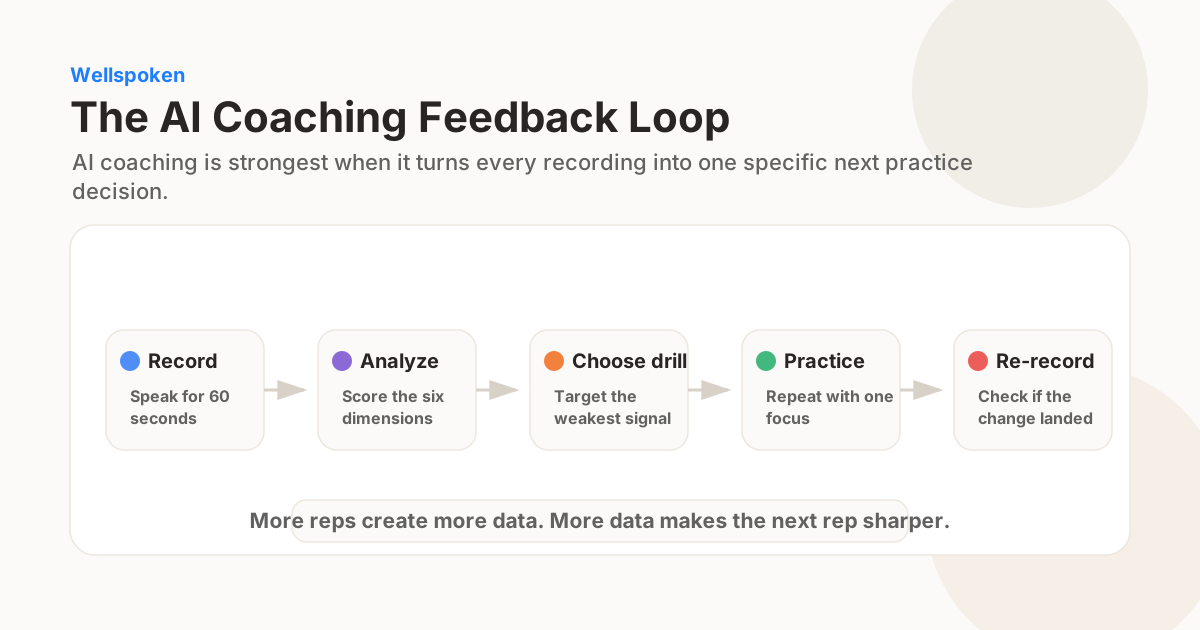
The most common mistake with AI coaching: using it passively. Recording yourself once, glancing at the score, and moving on is like going to the gym, doing one set, and leaving. The value comes from the feedback loop: record, review specific feedback, identify one thing to change, re-record, and check if the change landed.
Key Takeaway
AI coaching supports communication improvement by providing frequent, judgment-free practice with structured measurement after sessions. Use it for skill building: daily micro-sessions targeting your weakest dimension, with periodic trend review to check whether your practice is working. AI coaching catches patterns such as filler counts, pace variations, and structural gaps that human observation can miss. Pair it with human coaching or real-world practice for the strategic and cultural dimensions that AI can't evaluate.
FAQs
Can AI coaching replace a human speech coach?
For the skill-building phase of communication improvement, practice reps, measurement, and pattern detection are where AI coaching is most useful. For strategic coaching, including high-stakes situations, cultural calibration, and career-specific advice, a human coach adds value that AI can't replicate. The best approach uses both: AI for daily practice, human coaching for periodic strategic guidance.
How quickly will I see improvement with AI coaching?
Improvement depends on your starting point, the dimension you are practicing, and how consistently you record and review. Filler Rate can change quickly because counting fillers builds awareness. Structure and Conciseness often take more repeated practice because they require changing how you organize ideas.
Is AI coaching effective for non-native English speakers?
Yes. AI coaching can be useful for non-native speakers because it provides pronunciation feedback, repeated practice, and low-pressure review. Non-native speakers benefit from structured measurement because it separates clarity, which can be trained, from accent, which is a natural part of speech. Read more about fluency improvement for non-native speakers.
Practice with an AI coach that knows your speaking history and targets your weakest dimensions. Download Wellspoken