Summary: To stop rambling in meetings, organize your thoughts before you open your mouth: lead with your main point, support it with one or two reasons, and then stop talking. The core skill is verbal structure, the ability to sequence ideas in a logical order under real-time pressure, and it is trainable with timed compression drills.
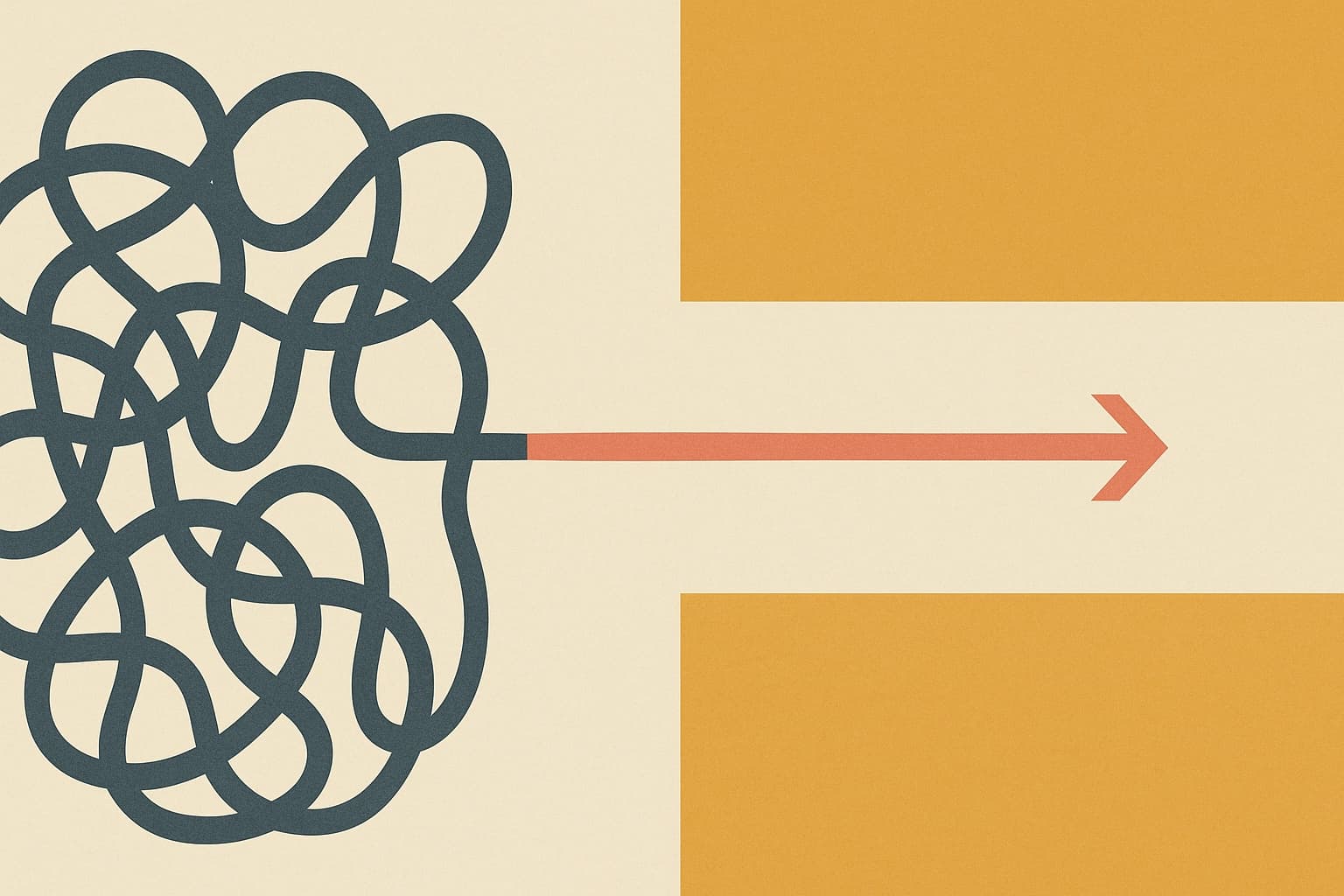
You stop rambling by organizing your thoughts before you open your mouth. Specifically, you lead with your main point, support it with one or two reasons, and then stop talking. Most people do the opposite: they start speaking to figure out what they think, and by the time they reach their point, everyone has tuned out.
The core skill here is called verbal structure, the ability to sequence your ideas in a logical order under real-time pressure. It's the difference between someone who "knows their stuff" and someone who can actually communicate it. And it's trainable. One of the most effective exercises is timed compression: you read an article, then explain the key concepts in 60 seconds, then 30, then 15. Each round forces you to cut filler and find the core of your message. Wellspoken's Speed Breakdown drill is built around exactly this mechanic, and it works because the progressive time pressure rewires how you prioritize information before you open your mouth.
This post breaks down why rambling happens, teaches you a framework you can use immediately, and gives you drills to build the habit over time. For a broader guide covering structure, vocabulary, and confidence alongside conciseness, see how to articulate your thoughts better.
The Moment Rambling Costs You
Rambling rarely feels like rambling while it is happening. It feels like being thorough. You add one caveat, then one background detail, then a second example because you want to be accurate. The listener experiences something different: they are waiting for the sentence that tells them what decision to make.
Picture a product review where someone asks, "Should we ship this Friday?" A rambling answer starts with context about the sprint, then the bug queue, then the customer request. A clear answer starts with, "Yes, if QA clears the checkout bug by Thursday." Everything after that sentence is support. The point-first version makes you sound prepared because the listener can orient immediately.
Why Do I Ramble When I Talk?
Rambling happens because your mouth starts moving before your brain has finished organizing. That's the short answer.
The longer version involves three overlapping causes. First, there's cognitive load. When you're thinking and speaking simultaneously, your brain defaults to a stream-of-consciousness output. You say everything in the order you think of it, which is almost never the order that makes sense to a listener.
Second, there's anxiety. A 2019 study at Cal Poly (Gikas & Sutcliffe) found that speakers who used more filler words and discourse markers were rated as having less professional credibility and lower communication competence, regardless of the speaker's gender. When you feel the pressure to sound smart or fill silence, you tend to over-explain, hedge, and circle back to points you already made. The irony is brutal: the harder you try to sound credible, the more you undermine yourself.
Third, there's a lack of a stopping point. Without a framework telling you when you're done, you keep talking because you're not sure you've said enough. This creates what communication coaches call "the spiral," where you restate the same idea in slightly different words, hoping one version lands.
Research published in Advances in Physiology Education (Seals, 2022) found that excessive filler use, one of the most visible symptoms of rambling, reduces a presenter's credibility and impairs audience comprehension. The study also identified a tipping point: once fillers exceeded roughly 1.3% of total words, success rates in professional communication dropped proportionally.
What Is the BLUF Method?
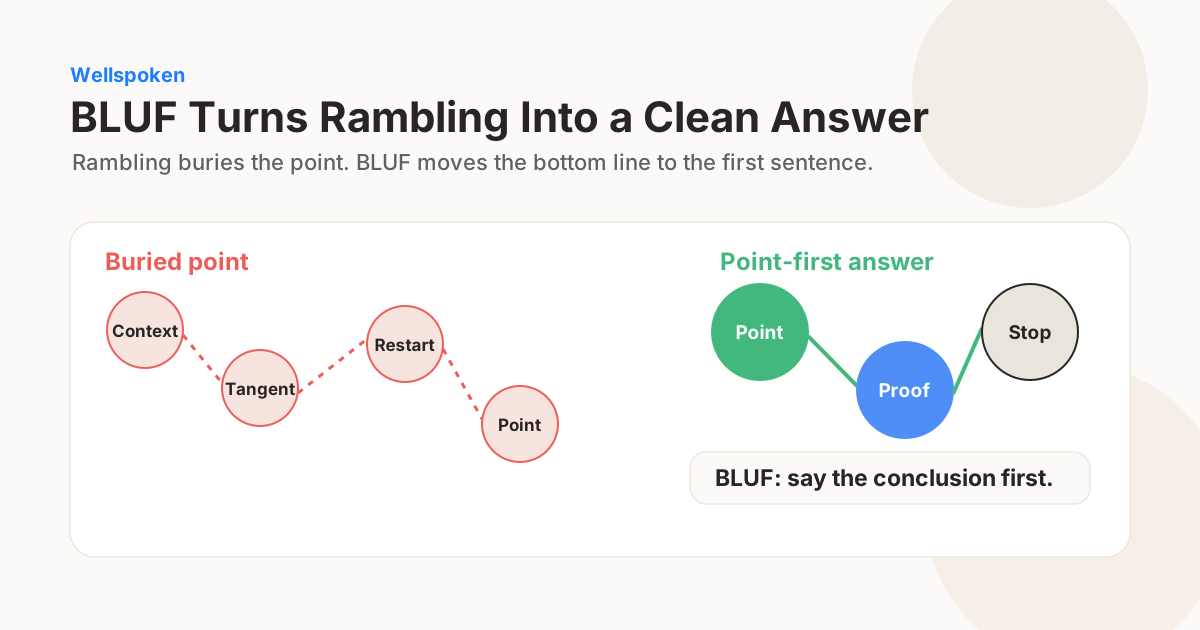
BLUF (Bottom Line Up Front) is a communication framework where you state your conclusion first, then provide the supporting details. It was developed by the U.S. military to ensure that critical information survived even if a message was only partially read.
Here's why it works for spoken communication: your listener's attention is highest in the first few seconds. A study from Throughline Group found that audiences in meetings and presentations can sustain focused attention for roughly 7 to 10 minutes under ideal conditions. When the topic is uninteresting or the speaker is unfocused, that window shrinks to seconds. BLUF puts your most important content exactly where your listener is most receptive.
"I think we should probably, you know, consider maybe looking into the possibility of expanding into the European market because the data sort of shows there might be some opportunity there, and I was thinking that if we looked at the Q3 numbers..."
Compare that to:
"We should expand into the European market. Q3 data shows 40% of our inbound traffic is coming from Europe, and we're leaving revenue on the table without localized pricing."
The first version buries the point under hedging and filler. The second leads with the recommendation and follows with evidence. Same person, same idea, completely different impact.
How Do I Use BLUF in Meetings?
Before you speak, silently answer one question: "What do I want this person to walk away knowing?" Say that thing first. Then give one or two supporting points. Then stop.
This three-step pattern works in almost every professional context. In a status update: "Project is on track for the March deadline. We cleared the two blocking issues this week and QA starts Monday." In a recommendation: "I think we should go with Vendor B. They're 15% cheaper and their implementation timeline is two weeks shorter." In a question: "Can we push the launch to April? The design team needs two more weeks for accessibility testing."
Each of those examples follows the same pattern. Lead with the point. Support briefly. Stop. The discipline of stopping is actually the hardest part. Most ramblers know their point. They just bury it at the end of a paragraph of context their listener didn't need.
How Long Should My Answers Be in Meetings?
For most meeting contributions, aim for 30 to 60 seconds. That's roughly 75 to 150 words.
This sounds short, and it is. That's the point. In Wellspoken's Speed Breakdown drill, users practice explaining an article's content in progressively shorter windows: 60 seconds, then 30, then 15. What users discover is that their clarity scores often increase as the time limit decreases. Constraints force you to prioritize, and prioritizing is the antidote to rambling.
A practical exercise: set a timer for 30 seconds and explain what you're working on right now. Just your main project. If you couldn't finish in time, you were including details your listener didn't need yet. They can always ask follow-up questions. That's preferable to over-delivering information they didn't request.
Does Rambling Hurt My Career?
Rambling erodes professional credibility faster than almost any other communication habit.
The research from Mortar Research is striking: in a study of 2,000 participants, listeners evaluated two speakers delivering arguments about the same topic. One spoke without filler words but presented inaccurate information. The other was factually correct but used frequent fillers. 57% of listeners rated the filler-free speaker as well-educated, compared to just 36% for the accurate-but-disfluent speaker. The fluent speaker was also rated as more intelligent and more likable.
This data doesn't mean accuracy is unimportant. It means that how you deliver information shapes perception as much as what you deliver. In professional settings, where decisions about promotions, leadership potential, and project ownership happen partly through informal conversations, speaking concisely carries real career weight.
Executive communication coach Lolly Daskal put it simply: if you go on and on to convey a straightforward idea, people will stop listening.
The 3-Before-Me Rule: A Daily Practice
The 3-Before-Me Rule is a simple technique to build conciseness into everyday conversations. Before you speak in any meeting or group discussion, silently count three things:
- My point. What is the one thing I want to communicate?
- My proof. What is the single strongest piece of evidence for it?
- My period. Where does this statement end?
That third element is the one people skip. Having a planned endpoint before you start talking prevents the spiral. You know where you're headed, so you don't wander.
Try this for one week. In every meeting, mentally run through point, proof, period before you unmute or raise your hand. You'll notice two things quickly. First, some contributions you were about to make weren't worth making. The 3-Before-Me filter catches those. Second, the contributions you do make will land harder because they're tighter.
Is Pausing Better Than Saying "Um"?
A silent pause is almost always better than a filler word in professional settings.
Psychology Today profiled research from Stanford psycholinguist Herbert Clark and psychologist Hans Rutger Bosker at the Max Planck Institute, which found that while fillers do serve a conversational function (signaling that you're still speaking and about to make a point), they carry a cost in formal contexts. In interviews, presentations, and meetings where preparation is expected, fillers signal hesitation and undermine perceived competence. In those same contexts, a brief pause reads as confidence.
The Wellspoken Index tracks filler rate as a dedicated scoring category worth 150 points, measuring total fillers, fillers per minute, and a full breakdown by type. This level of granularity matters because most people have no idea how often they use fillers until they see the data. Self-awareness is the first step in the research-backed approach to reducing fillers: awareness, feedback, then active replacement with silent pauses.
Practically speaking, the next time you feel an "um" forming, close your mouth for one full second instead. One second of silence feels like an eternity to the speaker. To the listener, it feels like nothing. That asymmetry is your friend.
How to Practice Speaking More Concisely
Reading about conciseness won't make you concise. You need reps. Here are three structured ways to build the skill.
Record and review. Record yourself answering a work-related question. Play it back. Count every filler, every repeated idea, every sentence that didn't add new information. This is uncomfortable the first time and transformative by the fifth. The Wellspoken app's Freeform Practice and Record Meeting features automate this analysis, but even a voice memo and honest self-assessment will show you patterns.
The 60-second challenge. Pick any topic. Record yourself talking about it for exactly 60 seconds with no stops, restarts, or edits. Then listen back. Did you state your main point in the first 10 seconds? Did you stay on topic or drift? This is the format behind Wellspoken's Daily 60 drill, and it's effective because the fixed time constraint forces structure.
Shrink the window. Explain something in 60 seconds. Then explain the same thing in 30. Then 15. Notice what you cut each time. The content you remove during this exercise is the content your listeners didn't need. This is the core mechanic of the Speed Breakdown drill, and it trains your brain to identify what's essential versus what's filler.
The key with all three: do them out loud. Thinking concisely and speaking concisely are different skills. You're training the second one.
Key Takeaway
Rambling is a structural problem with a structural fix. Lead with your point using BLUF, check yourself with the 3-Before-Me Rule (point, proof, period), and build the habit through timed speaking practice. Record yourself regularly, because the gap between how concise you think you are and how concise you actually are is almost always larger than you expect.
FAQs
Why do I ramble more when I'm nervous?
Anxiety floods your working memory, which makes it harder to organize thoughts in real time. Your brain compensates by talking through the problem out loud. The fix is to prepare your first sentence before you start speaking. That one sentence of structure gives your brain a runway.
Can filler words ever be a good thing?
In casual conversation, occasional fillers actually signal authenticity and help listeners track your thought process. The problem is excess, and context. In professional settings where preparation is expected (interviews, presentations, status updates), fillers reduce your perceived competence. Aim to be aware of them, not obsessed with eliminating every single one.
How long does it take to stop rambling?
Most people notice significant improvement within two to three weeks of daily practice. The critical factor is recording yourself and listening back, because awareness of the pattern is what allows you to interrupt it. Even five minutes of daily timed speaking practice can shift your default communication style within a month.
Start building your verbal structure today with Wellspoken's guided drills and real-time Wellspoken Index feedback. Download Wellspoken