
Summary: To structure your answer in a meeting, choose a framework like PREP, BLUF, or Point-Proof-Stop, identify your main point, and lead with it, which takes two to three seconds once practiced. Structure is the strongest predictor of whether listeners understand and remember what you said, so a structured 30-second answer outperforms an unstructured three-minute one.
You structure your thoughts before speaking by choosing a framework, identifying your main point, and leading with it. The entire process takes two to three seconds once you've practiced it. That pause before you speak is the difference between a rambling answer and a clear one.
Structure is trainable through repetition with frameworks. Research on message organization consistently shows it's the strongest predictor of whether listeners understand and remember what you said. A structured 30-second answer outperforms an unstructured 3-minute one. That's why Wellspoken includes a Framework Practice drill: you choose a communication framework (like PREP, Problem/Solution/Action, or What/So What/Now What), receive a random topic, and practice structuring a spoken response on the spot. The drill scores how well you adhered to the framework's sequence, so you get concrete feedback on whether your answer actually followed the structure or drifted into rambling. The more reps you do, the faster framework selection becomes automatic.
The 20-Second Version People Actually Hear
A structured answer feels almost too simple when you write it down. In a meeting, that simplicity is the whole advantage. Someone asks, "Should we keep this launch date?" You answer, "Yes, but only if we cut the reporting feature. The core flow is ready, reporting still has two open dependencies, and cutting it protects the customer-facing release."
That answer gives the listener a position, a condition, and a reason in under 20 seconds. It sounds decisive because the structure is doing invisible work. Without structure, the same answer becomes a tour through every dependency in the project. With structure, people can repeat your point after hearing it once.
Why Do I Lose My Train of Thought When Speaking?
You lose your train of thought because you start speaking before you know where you're going. Most people begin talking the moment they feel social pressure to respond, which means they're simultaneously generating content, organizing it, and delivering it. That's three cognitive tasks at once, and working memory can only handle so much.
Research on cognitive load theory explains why this happens. Your brain's working memory holds roughly four chunks of information at any time. When you're building your argument and speaking it simultaneously, those four slots fill up fast. The result: you forget your second point halfway through your first one.
The fix is a brief pause before speaking. Two seconds of silence gives your brain enough time to identify the destination of your response. Once you know where you're going, getting there becomes dramatically easier. Listeners don't notice a two-second pause. They notice a two-minute ramble. For the full system covering structure, vocabulary, and delivery, see how to articulate your thoughts better.
What Is the PREP Framework?
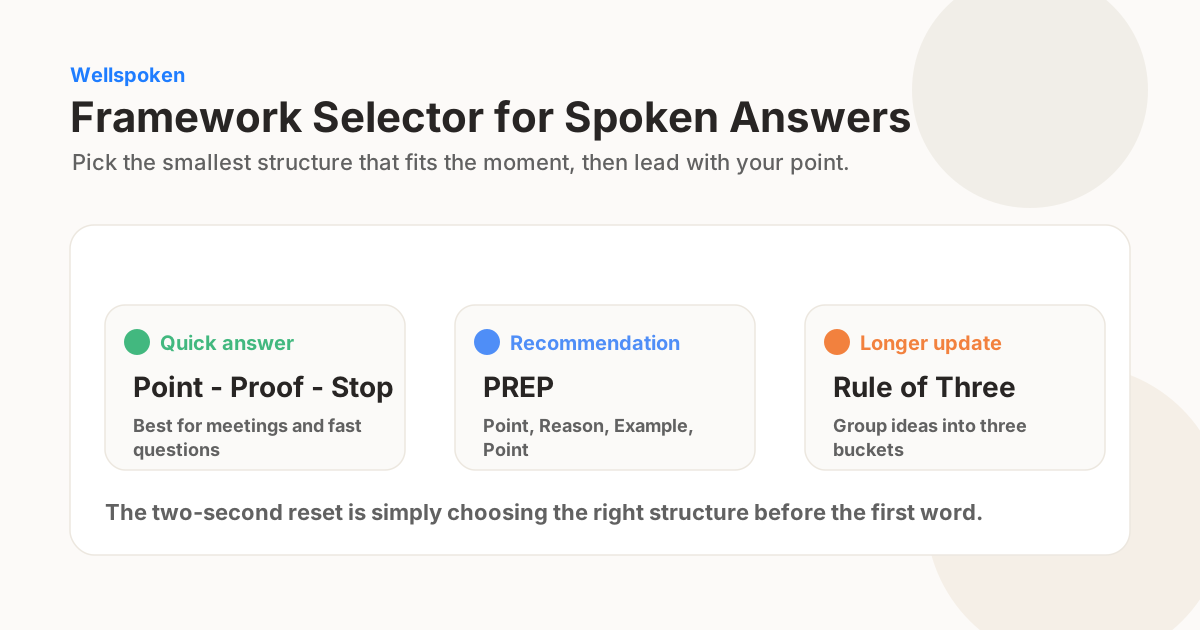
PREP stands for Point, Reason, Example, Point. It's a four-step structure that works for almost any question or comment in a professional setting.
Here's PREP in action:
Prompt: "Do you think we should expand into the European market?"
Point: "Yes, I think we should prioritize Europe next quarter." Reason: "Our product already has strong organic demand in the UK and Germany, and the regulatory pathway is clearer than in Asia." Example: "Last month, 18% of our inbound demo requests came from European companies, without any marketing spend there." Point: "Europe is the highest-return expansion opportunity we have right now."
That answer took about 20 seconds. It's structured, specific, and complete. A listener could summarize it in one sentence. Compare that to what most people do: "Well, I mean, it's interesting because there are a lot of factors to consider, and I've been thinking about this, and Europe is one option but there's also Asia, and I'm not totally sure, but maybe..."
PREP works because it front-loads your position (the first Point), then immediately justifies it. The listener knows within five seconds what you think and why. The rest is evidence.
How Do I Structure My Thoughts in Real Time?
Use the Two-Second Reset. When someone asks you a question, resist the urge to start talking immediately. Instead, take a breath, identify your main point, and then speak. That breath gives your brain the pause it needs to choose a direction.
The Two-Second Reset has three internal steps:
- What's my point? (Identify the one thing you want the listener to take away)
- What's my proof? (Identify one supporting reason or example)
- Go. (Lead with the point, follow with the proof, stop)
This is the Point-Proof-Stop technique. It's the simplest possible structure, and it's sufficient for 80% of workplace communication. Stand-up updates, meeting contributions, Slack huddle answers, quick opinions: Point-Proof-Stop handles all of them.
"We should delay the launch by two weeks. The QA backlog has twelve critical bugs, and shipping with that count will cost us more in customer support than the delay costs in revenue."
Point. Proof. Stop. Under 15 seconds.
How Many Points Should I Make When Speaking?
One to three points per response. One is ideal for quick contributions. Three is the maximum for longer answers. Beyond three, listeners lose track.
The Rule of Three is one of the most studied patterns in communication and rhetoric. Researchers have found that information grouped in threes is easier to process, remember, and repeat. "Life, liberty, and the pursuit of happiness." "Location, location, location." "Stop, drop, and roll." Three sticks. Four doesn't.
For spoken communication, this means:
- Quick answer (15-30 seconds): One point with one piece of evidence
- Standard answer (30-60 seconds): One point with two to three supporting reasons
- Detailed answer (60-90 seconds): Three points, each with brief support
If you need to cover more than three ideas, group them under three categories. "There are three areas to address: timeline, budget, and team. Under timeline, here are the two key dates..." This technique, called signposting, gives listeners a mental map before you start talking.
Signposting phrases that create structure instantly: "There are two things I want to highlight." "Let me break this into three parts." "The short answer is X. Here's why."
Why Does Unstructured Speech Feel Confusing to Listeners?
Unstructured speech forces listeners to do the organizational work you should have done. When ideas arrive in random order, the listener has to hold all of them in working memory, figure out how they connect, and determine what the main point was. That's exhausting, and most listeners stop trying after about 30 seconds.
Compare two versions of the same update:
Unstructured: "So I was working on the API thing, and then Sarah mentioned the design review, which reminded me we need to talk about the sprint goal, and also the client sent some feedback yesterday that's relevant to the redesign, and oh, I should mention the build is broken on staging."
Structured: "Three updates. First, the staging build is broken. I'm fixing it this morning. Second, the client sent feedback on the redesign. I'll share it in the design review tomorrow. Third, I want to revisit the sprint goal in our next sync."
The structured version has more words. It still feels shorter because the listener's brain can process each item cleanly before moving to the next. That's the power of structure: it reduces cognitive load for the listener, making you easier to follow and easier to remember.
How Do I Practice Structuring My Thoughts?
Framework repetition is the fastest practice method. Pick one framework (PREP, Point-Proof-Stop, or the Rule of Three) and use it to answer ten random questions in a row. Record yourself. The specific answers don't matter. You're training your brain to automatically slot ideas into a structure.
Here's a 10-minute daily practice routine:
- Pick 5 random prompts (use interview questions, news headlines, or conversation topics)
- For each prompt, take the Two-Second Reset (breath, identify point, go)
- Answer using PREP or Point-Proof-Stop
- Record all 5 answers as a single recording
- Play back and evaluate: did you lead with your point each time?
After two weeks of daily practice, most people report that structuring happens automatically. The frameworks become mental defaults rather than conscious tools. You stop thinking "okay, Point, Reason, Example, Point" and start naturally organizing your thoughts before you open your mouth.
For a more intensive approach, try the Speed Breakdown exercise: explain a concept in 60 seconds, then the same concept in 30, then in 15. Each compression forces you to find the structural core of your idea.
Key Takeaway
Structure your thoughts by learning one framework (start with PREP or Point-Proof-Stop) and using the Two-Second Reset before you speak: identify your point, identify your proof, then go. Keep responses to one to three points maximum. Practice by answering ten random questions per day with your chosen framework, and within two weeks the structure will become automatic. Your listeners will notice the difference before you do.
FAQs
How do I structure my thoughts when I'm caught off guard?
Use the Two-Second Reset: take a breath, identify your single main point, and lead with it. You don't need to have your full answer mapped out before you start. Leading with your point buys you time, because once the listener knows your position, they're oriented while you build your supporting evidence in real time.
Is it okay to say "let me think about that for a moment"?
Yes, and it's underrated. Saying "good question, let me think for a second" signals thoughtfulness. It's vastly better than filling the silence with "um, so, basically, like..." Most people overestimate how long a thinking pause feels to the listener. Three seconds of silence is barely noticeable.
Which framework should I start with?
Start with Point-Proof-Stop for everyday workplace communication. It's the simplest: state your point, give one supporting reason, and stop talking. Once that feels natural (usually one to two weeks), add PREP for longer answers where you need more structure. Save STAR for behavioral interview questions and storytelling contexts.
Build the structure habit with guided practice drills and instant feedback. Download Wellspoken