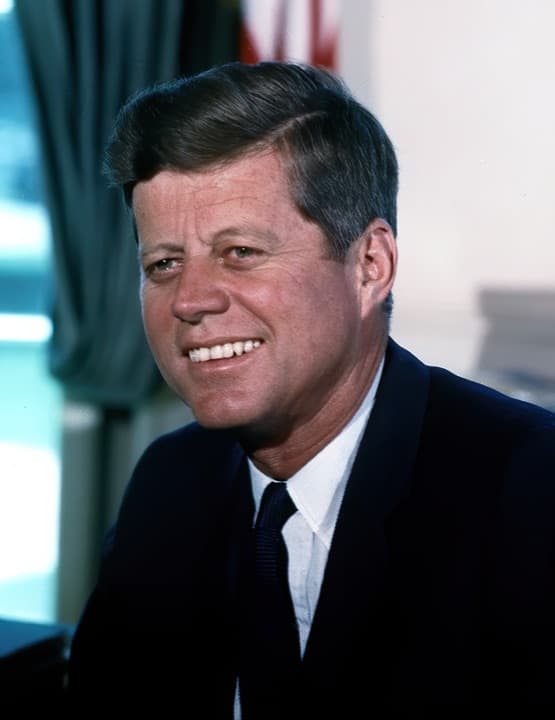
The breakdown
These scores are expert estimates produced from the Wellspoken Index rubric, not the production pipeline. The methodology link below explains how the dimensions are weighted. Read the methodology.
- Structure235 / 250 (94%)
- Conciseness172 / 200 (86%)
- Confidence146 / 150 (97%)
- Pronunciation140 / 150 (93%)
- Filler Rate140 / 150 (93%)
- Pace72 / 100 (72%)
In the recording
Inaugural address, January 20, 1961
And so, my fellow Americans, ask not what your country can do for you, ask what you can do for your country. My fellow citizens of the world, ask not what America will do for you, but what together we can do for the freedom of man.
- Structure / Antithesis. The line is a mirror: the same words reversed. That reversal is what makes it stick, the ear hears the symmetry and the mind keeps it.
- Confidence / Assertiveness. 'Ask not' is an imperative aimed straight at the audience. It instructs rather than suggests, with no softening.
- Pace / Pause Timing. Kennedy lands hard on 'country' both times and pauses before the second clause, giving the reversal room to register before he moves on.
How to speak like John F. Kennedy
Mirror the clause (antithesis)
Take a sentence and reverse its two halves. The symmetry makes a line quotable: 'ask not what your country can do for you, ask what you can do for your country.'
Practice: How to structure your answer in a meetingSpeak to the audience directly
Address listeners as 'you' and tell them to do something. A direct imperative pulls a passive audience into the message.
Engineer one repeatable sentence
Decide which single line you want people to carry out of the room, then build the passage so that line lands cleanly and on its own.
Practice: How to give shorter answers at work
FAQs
What rhetorical device is 'ask not what your country can do for you'?
It is a form of antithesis known as antimetabole, where the second clause reverses the word order of the first. That mirror is what makes the line so memorable.
Who wrote Kennedy's inaugural address?
It was drafted with his speechwriter Ted Sorensen, with Kennedy closely involved. Sorensen is widely credited with shaping the parallel and antithetical structures.
How fast did John F. Kennedy speak?
Kennedy tended to speak quickly, often estimated around 150 words per minute in this address. The clipped pace is offset by sharp pauses at the turn of each antithesis.