The breakdown
These scores are expert estimates produced from the Wellspoken Index rubric, not the production pipeline. The methodology link below explains how the dimensions are weighted. Read the methodology.
- Structure240 / 250 (96%)
- Conciseness176 / 200 (88%)
- Confidence149 / 150 (99%)
- Pronunciation146 / 150 (97%)
- Filler Rate140 / 150 (93%)
- Pace78 / 100 (78%)
In the recording
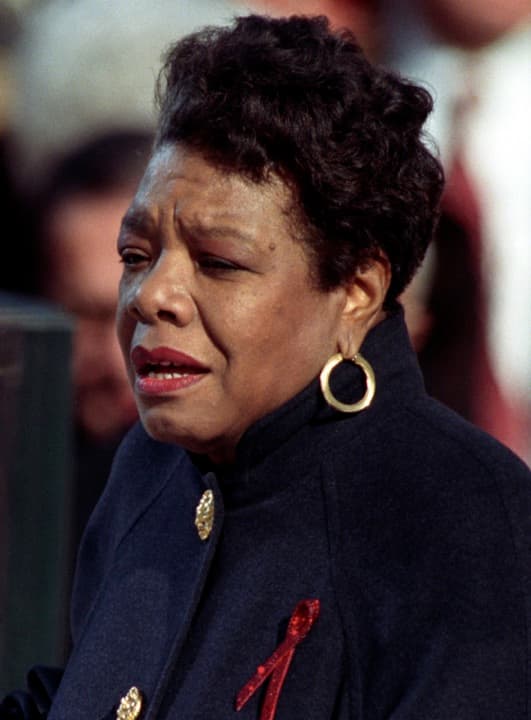
'Still I Rise,' from 'And Still I Rise' (1978), closing lines
Out of the huts of history's shame I rise. Up from a past that's rooted in pain I rise. I'm a black ocean, leaping and wide, welling and swelling I bear in the tide. Bringing the gifts that my ancestors gave, I am the dream and the hope of the slave. I rise. I rise. I rise.
- Structure / Signposting. The refrain 'I rise' returns at the end of each movement, so the listener always knows where the beat lands. The repeated phrase is the spine the whole reading hangs on.
- Pace / Pause Timing. The final three 'I rise' lines are delivered slow and spaced apart, each given its own breath. The lengthening pauses turn a refrain into a release.
- Confidence / Assertiveness. 'I rise' is a first person declarative repeated without qualification. No hedging, no conditional, just the same assertion stated until it becomes inevitable.
How to speak like Maya Angelou
Anchor on a returning refrain
Pick a short phrase and bring it back at each turn so listeners can feel the structure. Angelou lets 'I rise' mark every beat until the audience anticipates it.
Practice: How to sound confident in meetings without being loudSlow down for the close
As you reach the ending, stretch the pauses and give each final line its own breath. Angelou spaces the last three 'I rise' lines so the close opens out instead of rushing shut.
Move from image to plain statement
Build through rich imagery, then end on the simplest possible line. After 'a black ocean, leaping and wide,' the bare 'I rise' lands with more force for the contrast.
Practice: How to give shorter answers at work
FAQs
Why was Maya Angelou such a powerful reader of her own work?
She brought the cadence of the pulpit to the page. Angelou used repetition, deliberate pauses, and a steady climb in intensity so that a poem read aloud built like a piece of music toward its final line.
What makes 'Still I Rise' so effective when spoken?
The returning refrain gives the listener a structure to hold, and the lengthening pauses at the close turn that refrain into a release. By the final three lines the assertion feels earned rather than declared.
What can a speaker learn from Maya Angelou?
Anchor a passage on one short returning phrase, slow down as you approach the end, and let a plain line follow rich imagery. The contrast and the patience are what give the close its weight.