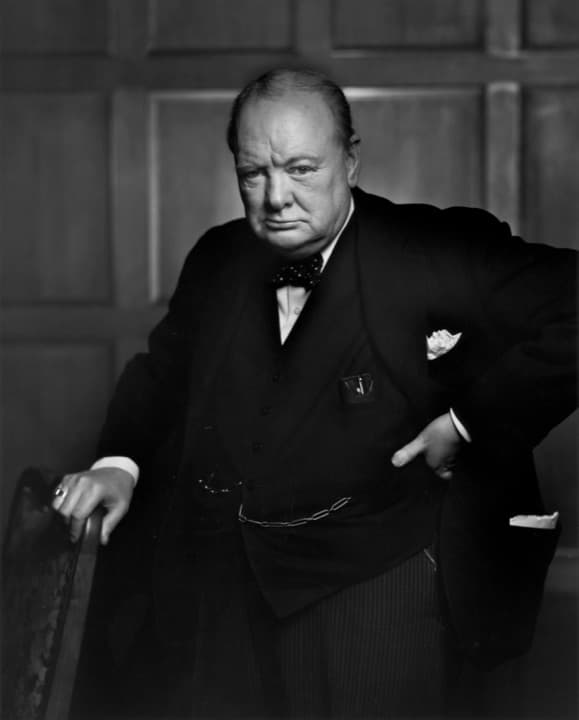
The breakdown
These scores are expert estimates produced from the Wellspoken Index rubric, not the production pipeline. The methodology link below explains how the dimensions are weighted. Read the methodology.
- Structure240 / 250 (96%)
- Conciseness168 / 200 (84%)
- Confidence150 / 150 (100%)
- Pronunciation140 / 150 (93%)
- Filler Rate138 / 150 (92%)
- Pace85 / 100 (85%)
In the recording
'We Shall Fight on the Beaches,' House of Commons, June 4, 1940
We shall fight in France, we shall fight on the seas and oceans, we shall fight with growing confidence and growing strength in the air, we shall defend our island, whatever the cost may be. We shall fight on the beaches, we shall fight on the landing grounds, we shall fight in the fields and in the streets, we shall fight in the hills; we shall never surrender.
- Structure / Signposting. Anaphora: nearly every clause opens with 'we shall fight.' The repetition becomes a drumbeat the audience can feel building toward a single resolution.
- Conciseness / Word Economy. Almost every load-bearing word is one syllable and concrete: fight, seas, fields, streets, hills. No abstraction to hide behind.
- Confidence / Assertiveness. Flat declaratives with no hedging. The shortest and most absolute sentence, 'we shall never surrender,' is placed last for maximum weight.
How to speak like Winston Churchill
Build with anaphora
Open consecutive clauses with the same words so the repetition itself carries momentum. Churchill repeats 'we shall fight' until the room feels the resolve.
Practice: How to sound confident in meetings without being loudChoose short, concrete words
Plain one-syllable nouns and verbs land harder than abstractions. Say 'fields and streets,' not 'various domestic environments.'
Practice: How to give shorter answers at workPut the most absolute line last
End on the shortest, least qualified sentence. After a long build, a four-word close lands as the conclusion the whole passage was driving toward.
FAQs
Why were Churchill's wartime speeches so effective?
They paired simple, concrete language with heavy repetition and a slow, deliberate delivery. The plainness made the message easy to absorb under stress, and the repetition made it easy to remember and repeat.
Did Churchill write his own speeches?
Largely yes. He dictated and revised them himself, then rehearsed aloud, marking the text for pauses and emphasis almost like a musical score.
What is anaphora?
Anaphora is starting several consecutive sentences or clauses with the same words. Churchill's 'we shall fight' sequence is one of the most famous examples. The pattern builds rhythm and anchors the argument in memory.