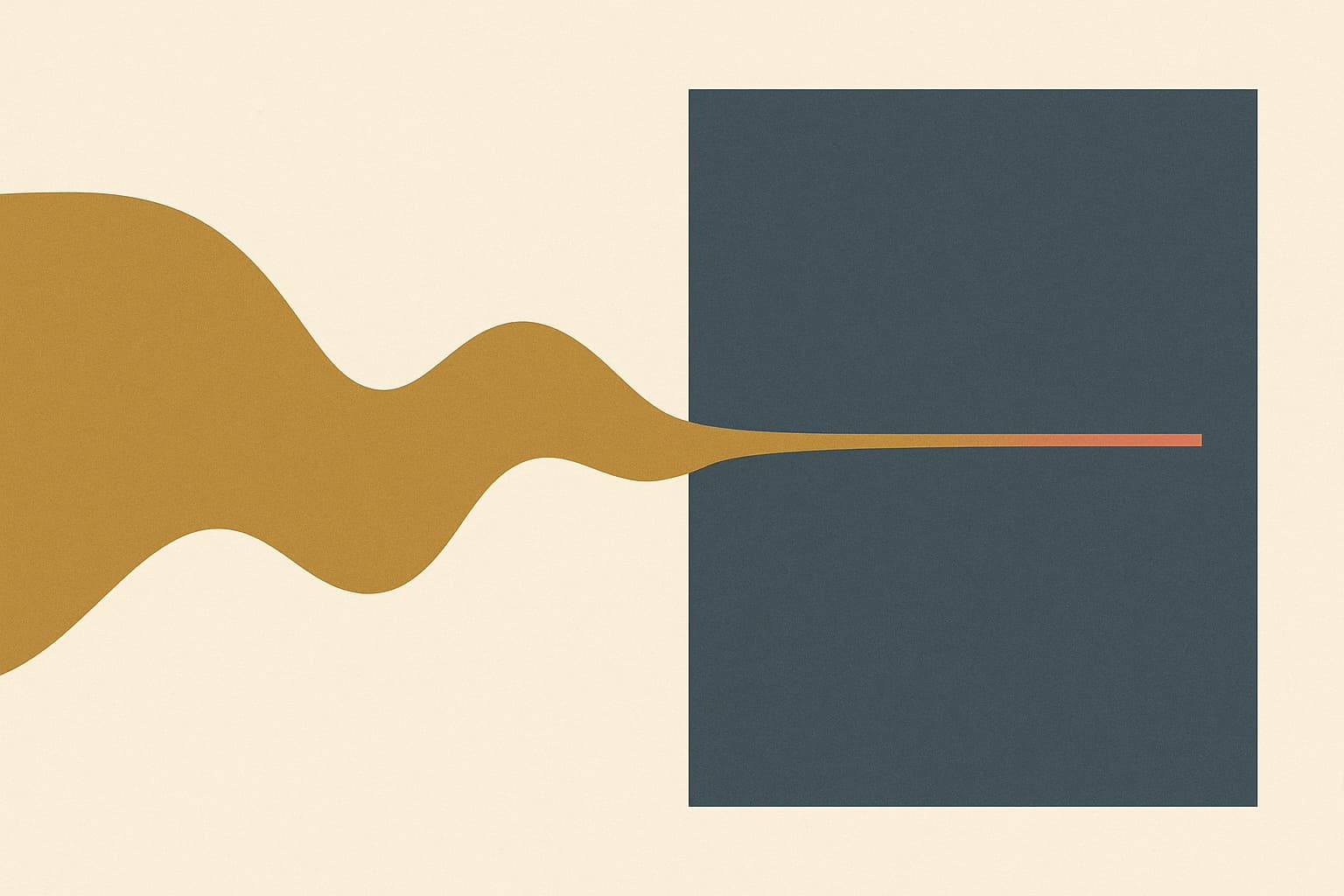
You become more concise by cutting words that don't carry meaning, not by cutting ideas. Concise speech delivers the same message in fewer words, with zero loss of substance. Verbose speech buries good ideas under qualifiers, restated points, and throat-clearing intros that the listener has to wade through.
Conciseness is measurable and trainable. After every recording, the Wellspoken Index tracks total words, average sentence length, long sentence count, and redundant phrase detection, so you can see exactly where the bloat lives. And the Speed Breakdown drill puts the training into practice: explain something in 60 seconds, then compress the same idea into 30 seconds, then 15. Each round of compression forces you to find the core and cut everything else. The combination of objective metrics and forced compression is what makes conciseness one of the fastest speaking skills to improve.
The Answer That Feels Too Short
Concise answers often feel rude to the speaker at first. You say one sentence, then your brain wants to soften it with context, disclaimers, and a quick apology for leaving details out. In many work moments, the shorter answer is the more respectful one because it gives the listener the exact information they asked for.
If your manager asks, "Are we blocked?" a concise answer is, "Yes. We need legal approval before we can send the email." That is enough for the first pass. If they need the history, they will ask. The skill is trusting the first clear answer instead of burying it under the full story.
Why Do I Talk Too Much When Explaining Things?
You over-explain because you're thinking out loud instead of delivering a conclusion. When you haven't identified your point before speaking, your mouth becomes a search engine, cycling through ideas until it finds the right one. The listener hears the entire search process, not just the result.
The other common cause: anxiety about being misunderstood. You add extra context, restate your point in different words, and throw in qualifiers ("I mean," "what I'm really trying to say is") because you're worried the listener didn't get it the first time. Usually, they did.
Research on spoken communication shows that listener comprehension peaks at around 30 to 60 seconds of continuous speech, then drops. Beyond 90 seconds, attention declines sharply. The practical implication: if your answer takes longer than 60 to 90 seconds (roughly 150 to 225 words), you're probably losing your audience.
What Is the One Breath Test?
The One Breath Test is a conciseness check: if you can't say your point in a single breath, you haven't distilled it enough. One breath is roughly 15 to 20 words, or about 8 to 10 seconds of speech. That's your core message.
Try it: take a breath, then state your main point. If you run out of air before you finish, your point has too many words in it. Strip it down.
Before the One Breath Test: "So basically, what I've been thinking is that we might want to consider the possibility of maybe pushing back the timeline for the project, because there are several things that have come up recently that I think could impact our ability to deliver on time."
After the One Breath Test: "We should push the project timeline back two weeks. Here's why."
The first version is 48 words. The second is 14. Both say the same thing. The 14-word version respects the listener's time and signals that you've done the thinking before you started talking.
What Are the Biggest Conciseness Killers?
Five patterns account for most verbal bloat: throat-clearing intros, hedge stacking, restated points, unnecessary qualifiers, and narrating your thought process. Knowing them lets you catch and cut them in real time.
1. Throat-clearing intros. "So basically, what I want to say is..." or "I guess my thought on this would be..." These phrases add zero information. They're verbal warm-ups, the speaking equivalent of clearing your throat before singing. Cut straight to the content.
2. Hedge stacking. "I kind of feel like maybe we should sort of think about..." One hedge is fine. Stacking three or four signals uncertainty and inflates your word count. Pick one qualifier or none.
3. Restated points. Saying the same thing twice in different words: "We need to move faster. What I mean is, we need to accelerate our timeline. Speed is really the issue here." The listener got it the first time.
4. Unnecessary qualifiers. "Very," "really," "quite," "a little bit," "somewhat," "kind of." These words dilute rather than strengthen. "The results are concerning" is stronger than "The results are a little bit somewhat concerning."
5. Narrating your thought process. "Let me think about this... so there are a few things coming to mind... okay, I think the first thing is..." The listener doesn't need a live feed of your internal deliberation. Pause silently, then deliver the conclusion.
How Long Should a Spoken Answer Be?
Fifteen to 90 seconds for most professional contexts. That's roughly 35 to 225 words. The ideal length depends on the complexity of the question and the setting.
Quick meeting contributions: 15 to 30 seconds (35 to 75 words). Stand-up updates, brief opinions, status check-ins.
Standard answers: 30 to 60 seconds (75 to 150 words). Interview responses, meeting discussions, explaining a recommendation.
Detailed responses: 60 to 90 seconds (150 to 225 words). Complex questions, presenting a proposal, walking through a decision.
Anything beyond 90 seconds in a group setting should be a scheduled presentation, not a spontaneous contribution. If your answer requires more than 90 seconds, say: "The short answer is X. I can walk through the details in a follow-up or after the meeting." This respects everyone's time and gives the listener a choice.
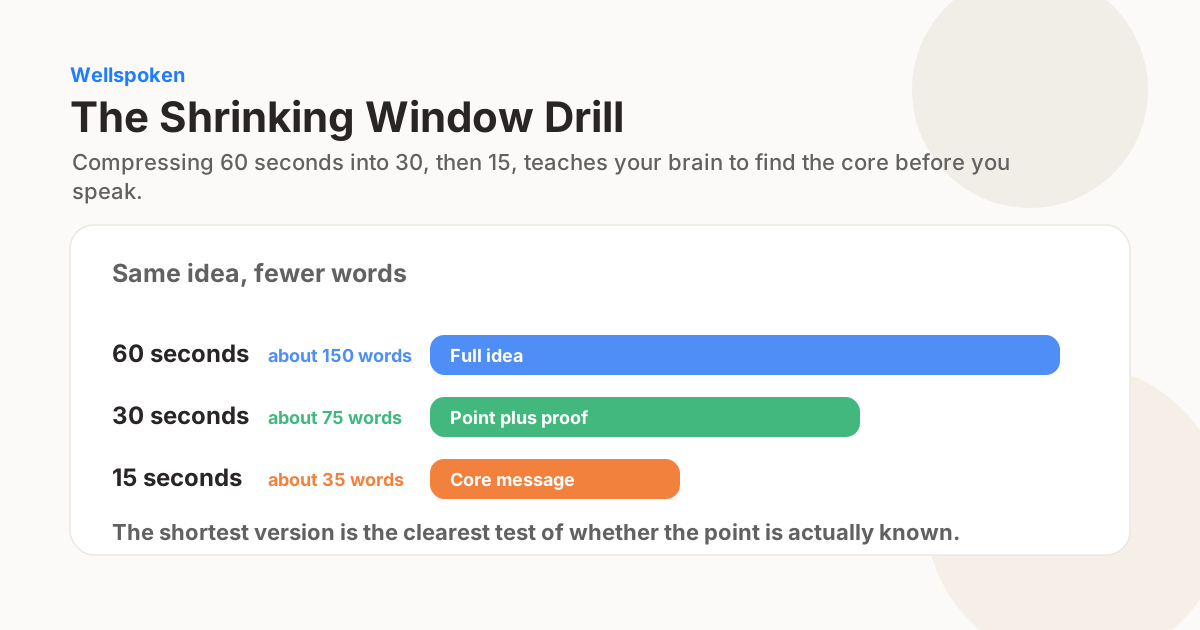
The Speed Breakdown exercise is one of the best conciseness drills: explain something in 60 seconds, then compress the same idea into 30 seconds, then 15. Each compression forces you to find the core of your message and cut everything else.
How Do I Be Concise Without Sounding Rude or Dismissive?
Warm conciseness uses tone and structure to signal respect while keeping words tight. Being concise means being efficient. The difference is in delivery.
Curt: "No."
Concise and warm: "I don't think that's the right direction. Here's what I'd suggest instead."
The warm version is still only 14 words. It acknowledges the other person's idea, states a position, and opens a constructive path forward. No hedging, no filler, no unnecessary softening.
Three techniques for warm conciseness:
1. Lead with acknowledgment. "Good question." "That's an interesting angle." One short phrase shows you heard the other person. Then deliver your concise answer.
2. Use your voice, not extra words, for warmth. A friendly tone with 15 words communicates more warmth than a monotone delivery with 50 words of hedging.
3. End with an opening. "That's my take. What do you think?" Twelve words, including an invitation for the other person to respond. Concise and collaborative.
How Do I Practice Being More Concise?
Two exercises produce the fastest results: the Shrinking Window and the Word Budget.
The Shrinking Window: Pick any topic. Explain it in 60 seconds. Record yourself. Now explain the exact same idea in 30 seconds. Then 15. Play all three back-to-back. Your 15-second version is your core message. Notice what you cut: those are the unnecessary words you habitually add.
The Word Budget: Before speaking in your next meeting, give yourself a word budget of 50 words per contribution. Count roughly as you speak. If you're approaching 50, wrap up. This constraint trains you to prioritize ruthlessly.
Track your progress with the Wellspoken Index, which measures conciseness through total words, average sentence length, long sentence count, and redundant phrase detection. Most people see their conciseness score jump within one to two weeks of focused practice, because cutting verbal bloat is one of the fastest speaking improvements.
Review your recordings with a specific lens: circle every word you could cut without losing meaning. Most speakers can trim 30 to 40% of their words on a first pass. More on stopping rambling.
Key Takeaway
Conciseness means delivering the same idea in fewer words, not shortening your ideas. Use the One Breath Test to find your core message, eliminate the five conciseness killers (throat-clearing intros, hedge stacking, restated points, unnecessary qualifiers, narrating your thought process), and keep answers under 90 seconds. Practice the Shrinking Window drill weekly, and you'll notice a difference within two weeks.
FAQs
Is being concise the same as being brief?
Being brief means using few words. Being concise means using the right words. A brief answer can still be unclear if it cuts essential context. A concise answer includes everything the listener needs and nothing they don't. Aim for concise, not just short.
How do I know if I'm being too concise?
If people frequently ask follow-up questions for basic context you should have included, you may be cutting too much. The fix: include your point and one piece of supporting evidence. Point-Proof-Stop. If they need more, they'll ask.
Does conciseness matter in casual conversation?
Less than in professional settings, but the same principles apply. In casual conversation, some verbal wandering is social bonding, not inefficiency. The people who struggle most with conciseness at work tend to apply the same patterns everywhere. Practice conciseness in professional contexts first, where it has the highest payoff.
Measure your conciseness with the Wellspoken Index and train with targeted drills. Download Wellspoken