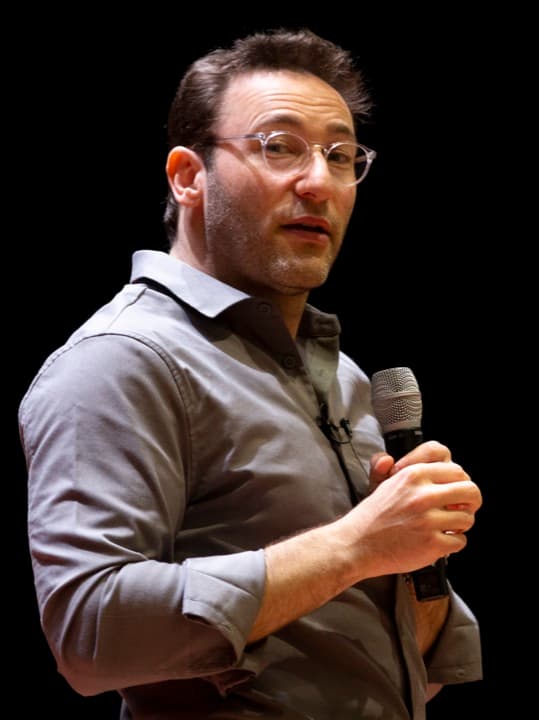
The breakdown
These scores are expert estimates produced from the Wellspoken Index rubric, not the production pipeline. The methodology link below explains how the dimensions are weighted. Read the methodology.
- Structure228 / 250 (91%)
- Conciseness160 / 200 (80%)
- Confidence138 / 150 (92%)
- Pronunciation138 / 150 (92%)
- Filler Rate128 / 150 (85%)
- Pace72 / 100 (72%)
In the recording
'How great leaders inspire action,' TEDxPugetSound, 2009
People don't buy what you do; they buy why you do it. And what you do simply proves what you believe. The goal is not to do business with everybody who needs what you have. The goal is to do business with people who believe what you believe.
- Structure / One Core Idea. The entire talk reduces to a single sentence stated early and repeated. Everything that follows is proof, not new argument.
- Conciseness / Word Economy. 'People don't buy what you do; they buy why you do it.' Eleven words carry the whole thesis. Nothing to trim.
- Confidence / Assertiveness. The core claim is stated as fact rather than opinion. No 'I think' or 'maybe' softens it, which is what lets the audience adopt it as their own.
How to speak like Simon Sinek
Compress your idea to one sentence
Before you build a talk, write the single sentence you want remembered. If you cannot say it in one line, the audience cannot repeat it.
Practice: Simon Sinek's Start With Why, summarizedRepeat the line, vary the proof
State your core sentence, then support it from different angles while returning to the same words. Repetition with fresh evidence reads as depth, not redundancy.
Start with why, not what
Open with the belief or purpose behind the work before describing the work itself. Leading with why gives the what something to attach to.
Practice: Simon Sinek's Start With Why, summarized
FAQs
What is Simon Sinek's Golden Circle?
A model with three rings: why, how, and what. Sinek argues that most people communicate from the outside in, starting with what they do, while the most inspiring leaders communicate from the inside out, starting with why.
What is Simon Sinek's most famous quote?
'People don't buy what you do; they buy why you do it.' It is the central line of his 2009 TED talk and the thesis of his book Start With Why.
Why is the Start With Why talk so popular?
It reduces a big idea to one repeatable sentence, supports it with a simple diagram, and states it with conviction. That combination is easy to remember and easy to retell, which is most of what makes a talk spread.