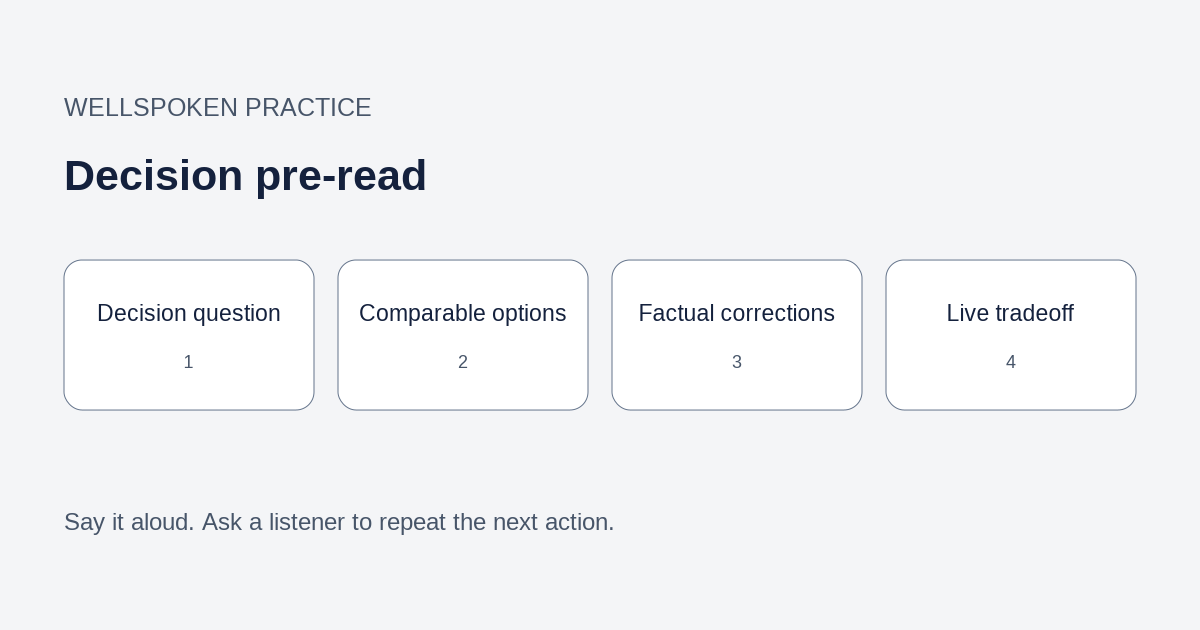
When your mind goes blank in a meeting, pause and say one sentence you can finish. Try “My main concern is timing” or “Let me think for a moment.” Give one reason, then stop or ask for the question to be repeated. You can also offer to check a detail and follow up.
For example, if someone asks whether the rollout is ready, start with “The release is ready, and I need to check the migration window before I confirm the date.” That gives the room a clear answer and names the part you still need to verify. Use your actual facts.
This page focuses on getting back into the conversation. For an answer that comes out tangled even when you remember the point, use the articulation practice guide.
The Blank-Mind Moment
The blank mind usually arrives after a simple question: "What do you think?" You had opinions during the discussion, but the direct invitation changes the task. Now you have to choose one opinion, arrange it, say it, and watch everyone react. That is when the screen goes white.
The fix starts before confidence. You need a default first sentence. Something like, "My main concern is timing," or "I would separate this into two issues." A default opener gives your brain a handle. Once the first sentence is out, the rest of the answer has a place to attach.
Why Do My Ideas Come Out Jumbled Even Though They're Clear in My Head?
Choose one part of the question to answer first. Trying to include every consideration at once can leave you without a clear opening.
Consider what happens when your manager asks, "What do you think about the new product direction?" In your head, you see five considerations at once: market positioning, engineering constraints, competitor moves, customer feedback from last quarter, and a half-formed idea about pricing. All of those are available simultaneously, connected by associations you've built over months. Your brain knows how they fit together.
The problem starts the moment you open your mouth. You have to pick one of those five threads and go first. Then you have to connect it to the next thread. Then the next. And while you're doing this, you're also monitoring your listener's face for confusion, managing your tone, searching for the right word (not "stuff," something more precise), and trying to remember the statistic you saw in that report last week.
For the product-direction question, you can start with the decision you support, then name one constraint. Keep the other considerations for follow-up questions.
Three factors determine how much jumbling occurs:
How many details you are trying to include. Put the decision first. Keep supporting facts for the next sentence or a follow-up question.
How much pressure you feel. You may be thinking about your answer and how the room is reacting at the same time. Afterward, review what the recording actually captured before judging the whole exchange.
Whether you have a structure. Most people start talking before they've chosen a sequence. They discover their point while making it. The result is backtracking, filler words, and sentences that dissolve before they arrive anywhere. Having a framework gives you a sequence to rehearse before the meeting.
Is This a Confidence Problem or a Skill Problem?
Pressure, preparation and difficulty organizing an answer can overlap. A single awkward exchange does not establish the cause.
Compare two recordings of the same question. In the first, take time to choose your point. In the second, ask someone to pose the question without advance warning. Note what changes, such as whether you lose the opening or struggle to find a supporting example.
Use that observation to choose practice. Rehearse an opening if that is where you stop. If fear of being judged is the bigger difficulty, consider support from a qualified professional as well as the speaking exercise. Our guide to sounding confident in meetings gives examples of clear, measured answers.
Why Does It Get Worse Under Pressure?
Worry can compete with the attention you need for the task. In a 2011 study by Coy and colleagues, anxiety-inducing evaluation instructions increased off-task self-talk and reduced performance on two working-memory tasks. Those laboratory tasks provide context for pressure and attention.
Another useful finding concerns how visible nerves feel. Savitsky and Gilovich’s 2003 public-speaking experiments found that speakers overestimated how apparent their nervousness was to listeners. A pause that feels conspicuous to you may deserve a second look on playback before you judge it.
Before your next meeting, write a short opening for the question you expect. “I recommend waiting until Friday” gives you a point to return to. Rehearse that sentence, one reason and an example using the PREP practice structure.
If you lose a specific detail, say what you can confirm and offer to check the rest. Avoid guessing merely to keep the answer moving.
Why Am I Better at Writing Than Speaking?
Writing usually lets you revise before the reader sees the answer. In a live exchange, you choose words while the other person listens.
When you write an email, you draft a sentence, reread it, delete three words, rephrase the opening, move the second paragraph to the top, and revise until the structure is clean. This process might take five minutes for a single paragraph. The reader sees only the polished result and assumes it came out that way.
Speaking doesn't offer that luxury. Every word is a first draft, delivered live, in sequence, with no undo button. You can't rearrange your second sentence to come before your first. You can't delete the tangent you wandered into. You can't swap "put together" for "consolidated" after you've already said it. The audience hears the full drafting process, and they experience it as confusion or rambling.
Use a written answer as preparation. Underline the sentence that answers the question, put it first, and try explaining it aloud without reading the rest.
This is why people who are excellent writers can be mediocre speakers, and vice versa. The two skills share a foundation (clear thinking) but differ in their output demands. Writing trains editing. Speaking trains performance. If you've spent years writing well and zero time practicing speaking, the gap makes perfect sense.
The comparison gives you something concrete to practice. If the written opening is clear, rehearse saying that point in your own words.
How Do I Start Fixing This?
Start by recording yourself for 60 seconds and listening back. This single action is the foundation of every improvement that follows.
Most people have never heard themselves speak in a conversational setting. The gap between how they think they sound and how they actually sound is consistently larger than they expect. You'll notice things immediately: filler words you didn't realize you used, sentences that lost direction, moments where your point got buried under unnecessary context. That noticing is the beginning of improvement.
Use the following as a practice plan. Move on when the next step is useful.
First, listen. Record a short answer to a work question. Play it back and note where you stopped or lost the thread. Wellspoken’s Daily 60 lets you enter a topic and record for up to two minutes. A 60-second answer is one practice option.
Then, choose the opening. Before recording again, decide on your main point. Say it, give one reason or example, and stop. Use the PREP structure if you need a sequence.
Next, practice a pause. Choose one place where you filled the space while deciding what to say. Pause there in the next take and listen to how it sounds.
Finally, change the question. Ask someone to pose a related question. Check whether you can still choose an opening, give a reason and finish the answer. Keep the recording to compare with another attempt.
Work on one change per recording so you can hear what it changed. If choosing an opening still takes effort, keep practicing that step before adding another.
For meetings on camera, how to stop rambling on Zoom calls and how to read the room on video calls cover the techniques specific to remote meetings. To practice with an app, see the best articulation training apps.
The Wellspoken Index scores both what you say and how you say it across six dimensions: Structure, Conciseness, Confidence, Pronunciation, Filler Rate, and Pace. That dual focus matters because communication feedback often favors either content or delivery. You could have a well-structured point that still lands poorly because your voice trailed off, your pace rushed through the key insight, or filler words broke your rhythm. Scoring both sides gives you a more specific picture of where the gap lives.
How Long Does It Take to See Improvement?
Progress varies. Compare a few recordings of similar questions using the same check. Did you return to your point after a pause? Could a listener repeat your answer?
Keep the question and recording conditions reasonably similar when you compare attempts. Use short speaking practice sessions to work on the part that still causes difficulty. Judge the change you can hear, rather than expecting a particular result by the end of a week.
Key Takeaway
Keep an opening sentence ready for the questions you expect. If you lose the thread, pause, return to that point, and give one reason. After the meeting, record the difficult question and listen for the moment you want to handle differently.
FAQs
Is this the same as social anxiety?
Trouble organizing an answer can occur with or without anxiety. The NIMH guide to social anxiety includes the mind going blank among possible symptoms. If fear or difficulty speaking interferes with daily life, seek professional assessment.
Why am I fine in casual conversation but freeze in important moments?
An important exchange can add time pressure and concern about how the answer will be received. Prepare a first sentence for the questions you expect, and practice returning to it after a pause. For persistent distress or difficulty speaking, seek suitable professional advice.
Can reading more books help me speak better?
Reading can give you vocabulary and examples of clear explanations. To practice answering aloud, take a point from something you read, close the text, and explain it in your own words. Listen back for whether the explanation stands on its own.
Rehearse your next meeting question in Wellspoken. The free plan includes three practices a week.
Correction, November 11, 2026. We corrected the research summaries, removed fixed improvement timelines, and clarified that difficulty speaking can have different causes.