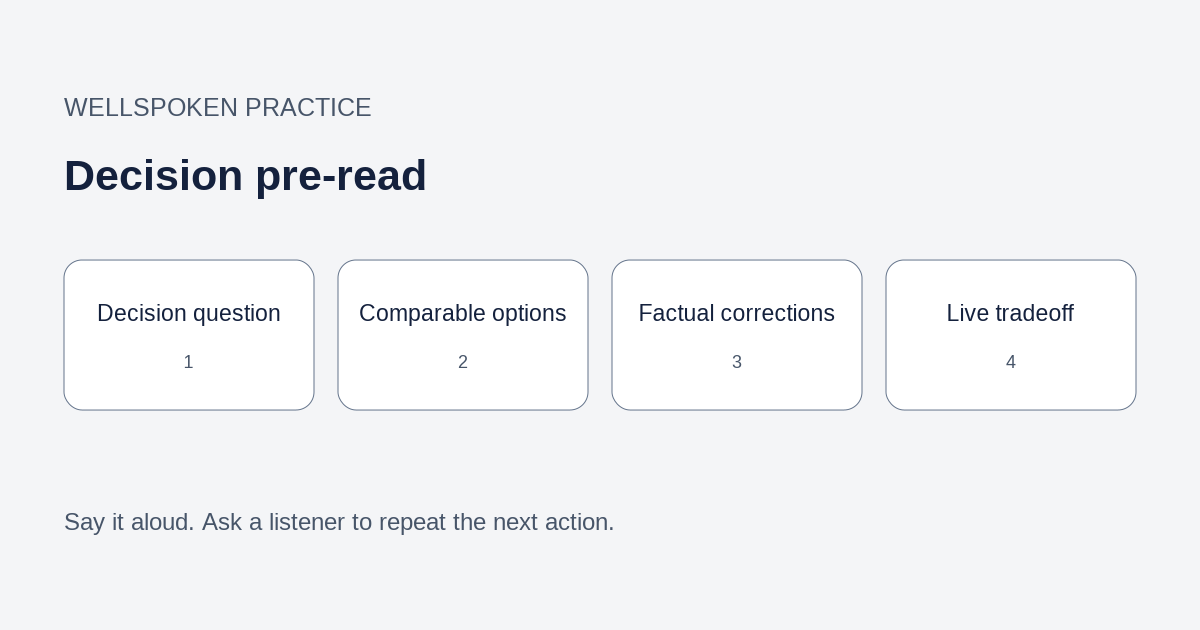
Before a meeting, send a brief that states the decision, essential background, options, evidence, requested preparation, and response deadline. Ask participants to correct facts or add risks before the call so live time can focus on unresolved tradeoffs.
Pre-work fails when it is a document dump or arrives too late. Effective asynchronous communication reduces the number of facts that must be narrated live while giving slower processors, different time zones, and domain experts a real chance to shape the meeting.
Lead with the decision
Put the exact question at the top. Readers should know why the material matters before opening links. Distinguish a decision meeting from a review, brainstorm, training, or announcement.
Compress background into necessary facts
Include only context required to evaluate the options. Link deeper history rather than copying it. Label assumptions and dates so readers can find stale information before it enters discussion.
Make options comparable
Use the same criteria for each option: benefit, cost, risk, dependency, and reversibility. Include "do nothing" where it is real. Avoid writing one option persuasively and describing the other as a caricature.
Ask for structured input
Request a preferred option, key risk, factual correction, or blocking question. A comment deadline makes it possible to synthesize input. "Please review" creates no shared definition of completion.
Open the meeting from the async record
Summarize corrections and unresolved points rather than replaying the document. Acknowledge input from people who cannot attend and show where it changed the agenda.
A script for the moment
"Decision for Tuesday: choose the pilot region. Read the two-page brief by the dated, named-zone deadline in the calendar invitation. Comment with your preferred option, the strongest risk, and any factual correction. I will update the comparison Monday afternoon. Tuesday's call will address the two unresolved tradeoffs and make the decision."
Create a decision brief checksum
Ask a colleague who did not help write the brief to state the decision, options, strongest evidence, preparation request, and deadline. Their restatement is the checksum. Any mismatch identifies a missing label or overloaded paragraph. Fix the core brief before adding more background links. Comprehension, not document length, determines whether the pre-work is ready.
Synthesize comments before the call
Sort responses into factual corrections, new evidence, option preferences, risks, and questions. Update the brief and publish the changes. Open the meeting with the two unresolved tradeoffs rather than a generic recap. If a time zone or function did not have a fair response window, delay the preference summary instead of presenting partial participation as consensus.
Design for correction rather than compliance
Add a visible "facts to correct" section near the top of the brief. Ask domain owners to verify only the claims they own before evaluating options. This prevents a participant from spending the response window debating recommendations built on a wrong baseline. After corrections close, publish a change note and extend the preference deadline if the evidence shifted materially. Rehearse the live opening using that history: what changed, which tradeoffs remain, and what decision is now possible. A good pre-read does not reward people for agreeing early. It makes disagreement better informed and exposes when the document must change before the group can decide.
Set a realistic response window
Calculate the window from the latest region to receive the brief, not the sender's upload time. Include working hours, weekends, holidays, document length, and whether domain experts must check evidence. If late information changes the options, extend the review rather than punishing early readers for responding to a stale draft. A fair window improves decision quality and prevents "asynchronous" from meaning that less powerful regions review material overnight. Archive the final brief with the decision so future readers can distinguish evidence available beforehand from reasoning added during discussion.
Limits and responsible use
Pre-work can shift meeting labor onto evenings or people in less powerful time zones. Set deadlines within working hours, keep the material proportionate, and treat accessibility as part of document quality.
Continue with structured meeting answers and practice the live decision opening.
Set a condition for moving between writing and a call
Use a written update when people can inspect information and respond separately. Keep live time when immediate questions, conflicting interpretations or a joint decision need interaction. A fictional update says: "Please review the two coverage options by Wednesday. If we agree on the constraint, the owner will decide in the document. If the estimates conflict, we will meet to resolve that difference."
Name the response deadline, decision owner and escalation condition. Make the result available to people who cannot attend a later call. For practice, convert a routine status meeting into a short note, then identify one question that would justify bringing people together. Judge the channel by the work it enables rather than by the amount of meeting time removed.
Frequently asked questions
How long should a pre-read be?
As short as the decision permits. Use a concise core brief with links to evidence rather than forcing every reader through the full history.
What if nobody completes the pre-work?
Inspect timing, relevance, workload, and clarity before blaming participants. Reschedule or narrow the decision when required evidence was not reviewed.
Should comments remain open after the meeting?
Set a clear correction window. Keep the authoritative decision record updated when later facts materially change it.
A pre-read for a meeting that might be canceled
Use this fictional example to test whether the live discussion is necessary:
"Decision: keep the current support handoff or test a shared queue. Evidence: the attached sample shows three unresolved ownership cases; it does not estimate how often they happen. Option A keeps the current process and adds an escalation owner. Option B tests a shared queue with one team. Please correct the sample or identify an implementation blocker by the dated deadline in the calendar invitation. The meeting is reserved for unresolved tradeoffs. If those are settled in the document, I will cancel it and record the decision."
The sample is explicitly limited. It offers a correction task before asking people to endorse an option. The cancellation condition gives the pre-work an actual consequence.
Rehearse two openings. In the first, the evidence is unchanged and one tradeoff remains. In the second, a participant shows that the sample is wrong. Practice updating the decision question in response. If the evidence changed materially, explain what review time the group needs before choosing. Reading the old script more fluently would preserve the wrong discussion.
Use concrete examples to show what each option would change for the people attending.