
Summary: "Tell me about yourself" trips up more candidates than anything that follows it, usually because they answer it as a résumé recap. Now-Then-Next covers where you are, the experience that got you there, and why this specific role is the obvious next move, in under 90 seconds. "Tell me about yourself" is usually the first question in the interview, and it trips up more candidates than anything that comes after it. The strongest answers cover three things in under 90 seconds. Where you are right now. The relevant experience that got you there. Why this specific role is the obvious next move. Everything else can wait or get cut entirely: the full résumé recap, the childhood backstory, the string of adjectives, the list of hobbies.
Most people default to one of two bad answers. One treats the question as an invitation to narrate an entire work history from the first internship onward, and the interviewer's attention drifts somewhere around minute three. The other swings too far the opposite way and produces something so vague it could describe almost anyone: "I'm a hard worker who loves a challenge and works well on teams." Neither version gives the interviewer anything to hold onto.
This question earns its reputation because it usually comes first, before the interviewer has anything to go on beyond your résumé. The tone you set in that first minute shapes how closely they listen to everything you say for the rest of the conversation.
What a Strong "Tell Me About Yourself" Answer Sounds Like
A strong answer sounds like a short, spoken story that moves from the present into the relevant past and back out toward the future. Here's what that sounds like out loud, before any explanation of how it works.
"Right now I manage onboarding for a 40-person software company, running the first 90 days for every new enterprise account. Before this, I spent four years on the support side, first answering tickets, then leading a team of five. That support background is actually why I care about onboarding: I kept seeing the same issues turn into support tickets every quarter, and I wanted to fix them earlier in the relationship instead of patching them after the fact. I moved into onboarding two years ago to do exactly that. My 90-day churn dropped by about a third. I'm talking to you because you're scaling this from one person doing everything into an actual team, and building that function from scratch is exactly the kind of problem I want next."
Notice the shape. The first sentence plants the listener in the present. The middle section moves quickly through relevant background, using it to explain a motivation rather than list a résumé. The last sentence connects that motivation directly to the room everyone is sitting in. That shape has a name, and it's worth learning on purpose instead of stumbling into it by accident.
Compare that to the generic version of the same background: "I'm a hardworking customer success professional with strong communication skills who's passionate about helping clients succeed. I have experience in both support and onboarding, and I'm looking for a new challenge." It's the same career and the same person. It just says almost nothing, with no number attached to it and nothing that couldn't apply to a hundred other candidates in the same field. That gap, between a structured answer and the answer most people give without meaning to, is the entire reason this question is worth preparing on purpose.
The Now-Then-Next Framework
The Now-Then-Next framework moves your answer from your current position, through the experience that explains how you got there, to a specific reason you're glad to be in this room. It exists because "tell me about yourself" is open-ended in a way that behavioral questions aren't, so it needs a shape of its own instead of one borrowed from a different kind of question.
STAR is for a different question: one specific past situation, told as a story. A different problem entirely. If that's what you're prepping for, the guide to speaking clearly in job interviews covers it in depth. Now-Then-Next is built for the wide-open version, where you're compressing a whole background into two minutes or less.
- Now. One or two sentences on your current role and what it actually involves day to day. A job title alone says nothing, so name the specific thing you own or are responsible for.
- Then. The stretch where you compress your relevant background into a throughline instead of a timeline. Pick one or two experiences that explain why you do what you do now, not every job that got you here.
- Next. One sentence that ties Now and Then directly to this specific role. Most people rush this beat or skip it entirely, and it's the one that tells the interviewer why they're talking to you instead of someone else.
The order matters more than people assume. Starting with the past, the way a résumé does, buries the most relevant information (what you're doing right now) under context the interviewer has to sit through first. Starting in the present hands them the headline immediately, then earns the rest of your two minutes to explain it. Newspapers lead with the headline for the same reason: a reader, or an interviewer, decides how closely to pay attention within the first few seconds, and a clear opening earns more of it than a slow windup does.
How Long Should Your Answer Be?
Aim for 60 to 90 seconds, somewhere around 130 to 180 spoken words, unless the interviewer specifically asks for more. That's enough time to give each beat real content without losing the interviewer's attention halfway through.
- Now: about 15 seconds. One or two sentences, no more.
- Then: about 35 to 45 seconds. The longest beat, since it's carrying your evidence.
- Next: about 15 to 20 seconds. Short and easy to remember.
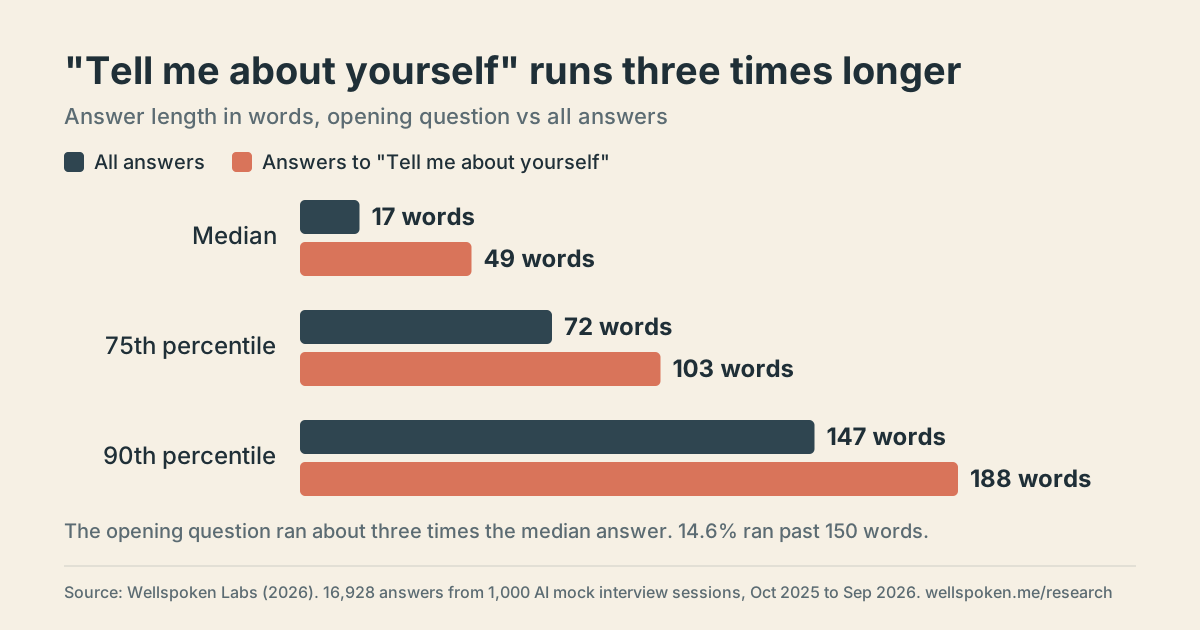
Most people land well short of that. In Wellspoken's study of 16,928 interview answers, the median response to "tell me about yourself" was 49 words, about 20 seconds of speech. Only about one in seven, 14.6%, ran past 150 words. The same question still produced answers three times longer than everything else in the interview, so it is where length control matters most, in both directions.
Senior or executive roles, or moments when the interviewer explicitly invites more with something like "walk me through your background," can stretch this toward two minutes. When that happens, put the extra time into the Then beat with one more concrete example, not into padding the Now or Next. A tight answer rarely draws a complaint. A long one almost always does.
Phone screens and first recruiter calls usually want something even shorter, closer to 45 seconds, since the recruiter is scanning for basic fit rather than making a final call. Save the fuller version for the hiring manager or panel round, where the extra context actually earns its place. If you notice partway through that you're running long, the cleanest recovery is a quick, direct wrap: "and that's the short version, happy to go deeper on any of it." That signals self-awareness instead of just trailing off.
Should You Talk About Your Personal Life or Just Your Career?
Default to career, and let in a personal detail only when it directly explains something in your Then beat. The person asking is building a case for hiring you, not making conversation with a stranger at a party.
The safest version of this answer stays entirely professional unless the interview's tone clearly invites more, which happens most often in casual, founder-led interviews at small companies. Even then, one sentence is the limit. It only earns its place if it sharpens the why behind your career choices.
Growing up translating for your parents, and later gravitating toward client-facing work because you're comfortable being the bridge between two groups, is a personal detail doing real work. A detail that doesn't connect to anything, your hometown, your favorite hobby, just eats time that could go toward your Then beat's evidence.
Health information, relationship status, religion, and anything else outside the scope of the job all fit better later in the process, once you've actually built a working relationship with the interviewer.
How Do You Tailor This Answer to a Specific Job?
Find the one need the job posting emphasizes most, then make sure your Next beat names that need directly while your Then beat backs it up with evidence. Your Now beat can mostly stay fixed across interviews. Your Next beat, and which piece of your background you foreground within Then, should change for almost every interview you walk into.
Take the onboarding example from earlier. If the job posting is mostly about building a team out of a single-person function, the Next beat leans into scaling: "you're going from one person doing everything to an actual team, and building that function from scratch is exactly the kind of problem I want next." If the same posting instead emphasizes reducing churn through data, the Then beat shifts to foreground a different project, and the Next beat follows it: "your posting is almost entirely about using onboarding data to predict churn before it happens, and building the dashboard that flagged our at-risk accounts early is the project I'd want to bring here." Same person, same background, two different endings, because the jobs are asking for two different things.
Keep a short running document with two or three alternate details for your Then beat and three or four alternate closing lines for Next, each matched to a different emphasis: scaling, technical depth, cross-functional work, or cost reduction. Fifteen minutes reading the job posting the night before, matched against that document, beats writing new material from scratch every time.
The job posting is the fastest source, but it isn't the only one. A company's recent news, like a product launch or a leadership change, can sharpen the Next beat even further if you tie your background to what's happening right now instead of only what the role description says.
What's the Biggest Mistake People Make With This Question?
The most common mistake is treating the question as a request for a full biography instead of a 90-second pitch, which is exactly what produces the rambling everyone dreads. A close second is the opposite failure: an answer built entirely out of generic traits that could describe almost anyone in the building.
The rambling version usually starts in college, or earlier, and narrates every job change in order, including the one internship that has nothing to do with the role. Recorded run-throughs of that version routinely stretch past three minutes once someone starts narrating chronologically. That's more than double the useful length, and most interviewers have mentally moved on well before the two-minute mark. If rambling shows up in your meetings too, not just interviews, the fix is the same one at work here: treat your background as a highlight reel, not a timeline. Pick one or two experiences that build toward your Next beat and cut the rest, even when it feels like you're leaving something important out.
The generic version leans on words like "hardworking," "passionate," "motivated," and "team player," with nothing attached to back them up. Every claim needs a specific number or a named project riding along with it, or it should be cut. "I'm detail-oriented" says nothing on its own. "I caught a pricing error in a contract that would have cost us $40,000" says the same thing and gets remembered.
A smaller third mistake: trailing off without a real Next beat, something like "so yeah, that's pretty much me." If your answer doesn't end by pointing at the job in front of you, the interviewer has to do that connecting work themselves, and not every interviewer will bother.
How to Practice Your Answer Until It Sounds Natural
Write your three beats as bullet points, not a full script, then say the answer out loud ten to fifteen times, changing the exact wording a little each time. Memorizing a script word for word is the fastest way to freeze the moment an interviewer interrupts or asks a follow-up you didn't plan for.
Time yourself against the 60 to 90 second target from a few sections back, and record a handful of the run-throughs so you can listen back instead of guessing how it sounded. Most people find the same pattern when they hear their own recording. The Then beat runs long and vague on the first few tries, then tightens up fast once you've said it out loud five or six times. That repetition is where the actual improvement happens, not the writing stage.
It also helps to practice the follow-up. Interviewers sometimes respond to a strong Next beat with a direct question, something like "what about this role interests you most specifically." Having already thought through the reasoning behind your Next beat means you're expanding on something real instead of improvising it for the first time under pressure.
This is also exactly the kind of practice that benefits from talking to something that talks back instead of a blank page. Wellspoken's in-app coach, Echo, runs mock interviews and role-play scenarios, so instead of reading advice about the Now-Then-Next structure, you can say your actual answer out loud and hear how it lands. Every scored session is rated across six dimensions, including structure and conciseness, as part of the Wellspoken Index, a 1000-point score. That means you'll know if your Then beat is running long before you find out live in front of an interviewer. The free tier includes three scored practice sessions a week, and Pro runs roughly $70 to $110 a year if you want more room to practice.
Key Takeaway
Now-Then-Next replaces the two default failure modes, the full-life ramble and the generic-adjective answer, with a 60 to 90 second structure built around your actual current role and a genuine reason you want this one. Keep your Now and Then mostly fixed across interviews. Rewrite your Next beat, and whichever piece of Then you foreground, to match whatever the job posting cares about most.
FAQs
Should you memorize your answer word for word?
No. Memorize the three beats and the specific evidence inside each one, not the exact sentences. A word-for-word script tends to fall apart the moment an interviewer interrupts with a follow-up, while a memorized structure lets you keep going in your own words.
What if your career path doesn't connect in a straight line to this job?
Use the Then beat to name the thread connecting the moves, whether that's a specific skill you kept returning to or a type of problem you kept choosing to work on. Interviewers are far less bothered by a nonlinear background than by a candidate who can't explain it. One clear sentence naming the thread does more work than trying to justify every individual job change.
Can you start with something other than your job title?
Yes. You can open with a one-line description of the problem you solve or the mission behind your work instead of a literal title, as long as you land clearly in the present within your first sentence or two. What matters is that the interviewer knows where you are right now before you move into the Then beat, not the exact words you use to say it.
Practice your "tell me about yourself" answer with Echo, Wellspoken's AI coach, and see your Now-Then-Next structure scored before the real interview. Download Wellspoken
Comparing practice tools first? See the full ranking of interview practice apps.