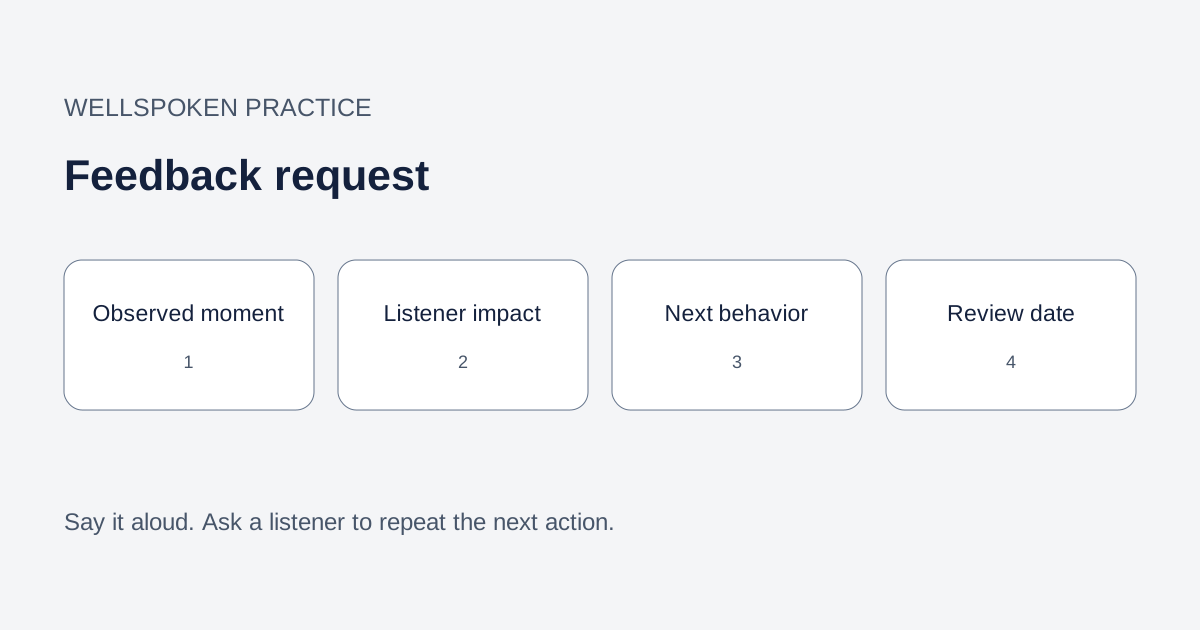
Ask for useful feedback by naming the skill or situation, requesting a recent example, and defining what better performance would look like next time. A question tied to a witnessed event gives the manager a concrete example to discuss.
Why broad requests produce weak feedback
"Do you have any feedback for me?" is easy to answer with "nothing right now." The question is broad, requires instant memory search, and can feel socially risky. Specific prompts reduce that burden and signal that you intend to use the answer.
Acas includes regular feedback and check-ins alongside formal performance reviews. Its guidance also recommends sharing a written record after a review. Use the same habit to keep your development experiment clear.
Ask for evidence you can test
1. Choose one observable area
Ask about a recurring situation such as project updates, facilitation, or technical explanations. Avoid requests for a verdict on your overall personality.
2. Request a recent example
An example lets you see the behavior and context. If the person has none, ask what they would watch in the next meeting instead of forcing an invention.
3. Clarify the desired difference
Ask what a stronger version would have sounded or looked like. This converts evaluation into a practice target.
4. Close with a follow-up loop
Summarize what you will try and invite observation at a named opportunity. Later, report back on what changed and ask what the person noticed.
Compare "any feedback" with a focused request
Less useful: "Can you give me any feedback on how I am doing?"
Stronger: "In stakeholder reviews, does my opening make the decision clear? Can you point to the last time it worked or became hard to follow? In Thursday's review, I am going to lead with one recommendation. Could you watch whether the discussion gets to the decision faster?"
The stronger request names the behavior, recent situation, and future standard. It gives the manager a retrieval cue and signals that a concrete example is welcome.
Practice receiving three kinds of response
Write five broad feedback questions. Narrow each to one setting, one behavior, and one recent example. Practice receiving a difficult answer with only three moves: thank the person, paraphrase the observation, and ask one clarifying question. Save explanation for later if it is truly needed.
Role-play three manager responses: specific feedback, vague praise, and a surprising criticism. Practice asking for an example without arguing or treating one observation as a full diagnosis.
Rehearse the request and follow-up aloud in Wellspoken, then check the substance with someone who observed the work.
Bias, observation, and managerial power
The person you ask may lack enough observation or expertise to judge the skill. Treat one view as a signal, not a diagnosis. For formal performance expectations, ask the accountable manager for explicit standards. You can consider feedback carefully without accepting every suggestion.
A manager may lack direct observation or may give biased feedback. Seek another informed perspective when the claim is broad, identity-coded, or unsupported by an example.
Turn one comment into an experiment
Suppose your manager says your updates are hard to follow. Ask for the most recent example, where the listener lost the thread, and what they needed earlier. Convert the response into one test: state project condition in the first sentence for the next three updates. Return with those examples and ask whether the specific behavior changed the outcome.
Feedback-request FAQs
What should I ask instead of a general feedback request?
Name a recent task and one dimension, such as clarity of the recommendation or handling of questions, then request a specific example.
How do I respond to vague feedback?
Ask what the person observed, what impact it had, and what a stronger version would look like in a similar situation.
What if I disagree with the feedback?
Reflect the claim accurately, ask for evidence, and state any context that changes the interpretation. You can test a useful behavior without accepting an unsupported label.
Related practice for feedback requests
For feedback requests, pair the meetings library with professional work conversations.
Practice a focused feedback request and a calm evidence-seeking follow-up in Wellspoken.
What if your manager says everything is fine?
Bring a specific moment they witnessed. "In Tuesday's review, I answered the budget question with the implementation history. Was that the detail you needed, or did you need my recommendation first?" The question gives the manager a concrete choice. It also allows them to say that the original answer was useful.
If they did not attend, choose a future observation: "Could you watch the opening of Thursday's update and tell me which decision you think I am asking for?" Arrange this before the meeting so the request does not depend on someone reconstructing a performance from memory.
For practice, use three response cards: "Fine," "Too much detail," and "You sounded unsure." Have a partner select one. Your task is to ask for an example and identify one observable change, while leaving room for disagreement. A useful response to the last card is: "Which sentence gave you that impression? I want to separate uncertainty about the forecast from uncertainty about my recommendation."
After the real one-on-one, write the example and proposed experiment in two sentences. Ask the manager to correct your interpretation before the next attempt.
For the next attempt, use meeting answer structure to test a specific change in your opening.