Direct answer: Answer a conflict interview question by naming the work disagreement in neutral terms, explaining what you did to understand the other person, describing the decision you helped reach, and ending with the work result. Keep blame and personality judgments out of the story.
Choose a story that makes your judgment visible. Explain what each person needed, how you checked the disagreement, and what you personally did to move the work forward. Keep enough detail for the interviewer to ask a follow-up about your decision.
What the Interviewer Is Evaluating
Structured interviews often use past behavior to assess job-related competencies. A conflict story can reveal communication, teamwork, self-awareness, and decision-making at once. The useful evidence is behavioral: what you asked, changed, proposed, or documented. For the broader timing and proportion of a behavioral story, use the 1-3-1 structure for behavioral interview answers.
The weakest answers spend most of their time describing a difficult coworker. Even when the description is accurate, it gives the interviewer little evidence about your own skill. Replace labels such as "stubborn" or "unreasonable" with an observable difference: "We disagreed about whether to delay the release for another round of testing."
Use the Difference, Dialogue, Decision, Result Structure
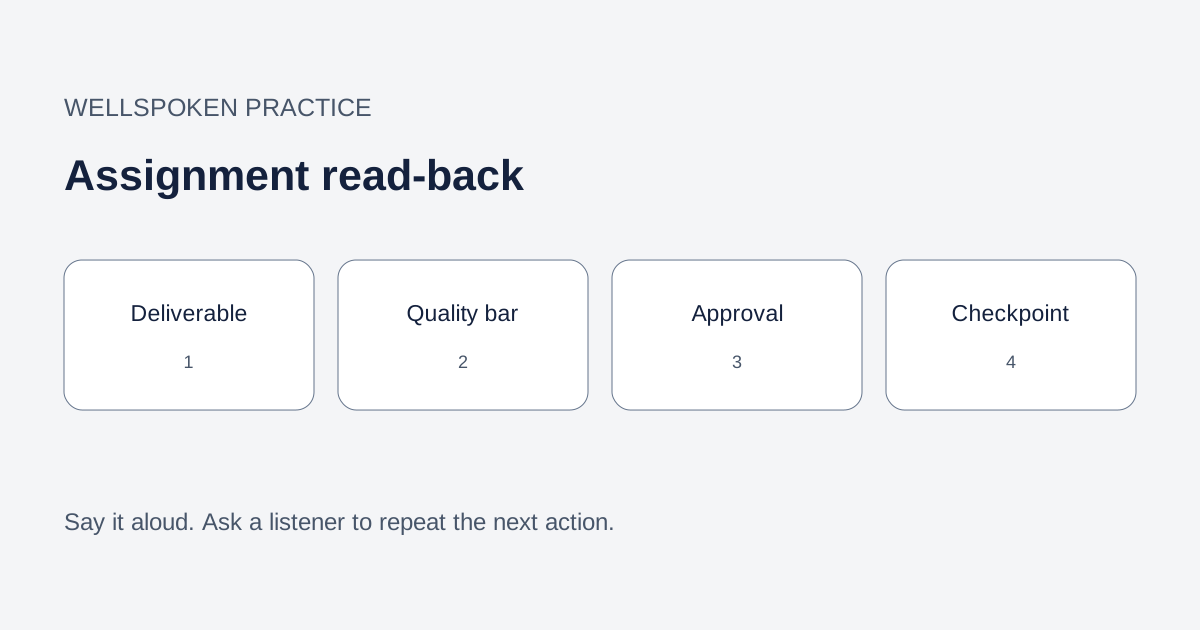
Use this four-part rehearsal checklist to organise your example. This Wellspoken coaching aid gives you four things to listen for when reviewing a recording.
- Difference: State the business disagreement in one or two sentences.
- Dialogue: Explain how you learned the other person’s constraints or reasoning.
- Decision: Describe the proposal, tradeoff, or escalation you used.
- Result: Name the outcome and what changed afterward.
Most of the answer should cover Dialogue and Decision. That is where the interviewer can see your behavior. The background needs only enough detail to make the disagreement understandable.
Example of a Strong Conflict Answer
Question: "Tell me about a conflict with a teammate."
Illustrative answer, using a fictional workplace situation: "A product manager and I disagreed about releasing a reporting feature before quarter end. I was concerned about two unresolved data-quality issues, while she was responsible for a customer commitment tied to the date. I asked us to list the failure modes and the customer consequences side by side. We agreed that one issue could be monitored, but the other could produce incorrect invoices. I proposed releasing the dashboard on schedule while holding the billing export for three days. Engineering fixed the blocking issue, the customer received the visible part on time, and we added a launch checklist that made ownership of data validation explicit."
The candidate never calls the product manager careless. The answer makes both constraints legitimate, then shows how the candidate moved the work forward.
What If You Have Never Had a Serious Conflict?
Start with a small difference that affected the work. You might have disagreed about a deadline, who owned a task, or how much checking a piece of work needed. Explain why the choice mattered and what you did to resolve it. A calm disagreement can give you enough material for the answer.
For example, think through these prompts before you start recording:
- Did two people expect different things from the same handoff?
- Did you propose a different order for competing deadlines?
- Did someone challenge an assumption and change the plan?
Choose an event you remember well enough to explain when questioned. If a project detail is uncertain, check it or leave it out. If you have no workplace example, name the setting plainly: a student project, volunteer role, or part-time job. The interviewer can decide how closely that experience matches the role.
An opening could be: "I have not had a major personal conflict at work. One disagreement about task ownership taught me to check the handoff earlier." Continue with the actual event. Keep the difference proportionate instead of turning a routine discussion into a dramatic confrontation.
What If You Were Partly Wrong?
Say so plainly. Accountability gives the interviewer concrete evidence that your goal was a sound decision rather than personal victory.
For example: "I initially argued for replacing the vendor. After reviewing the support history, I realized I had over-weighted one recent failure. I changed my recommendation to a 60-day improvement plan with specific service targets."
Do not manufacture a mistake to appear humble. If your original position remained correct, identify something you could have handled better, such as involving the other person earlier or explaining the risk more clearly.
How to Handle an Unresolved Conflict
Not every disagreement ends with consensus. You can still give a strong answer if you explain the decision process and your conduct after the decision.
Use language like: "We did not agree on the preferred option. Our director chose the phased rollout after hearing both cases. I documented the risks, supported the decision, and set up the monitoring we would need."
That answer demonstrates mature disagreement. Avoid implying that cooperation means suppressing a legitimate risk. Professional conflict can include escalation when the stakes or decision rights require it.
A Three-Take Practice Exercise
Choose one real disagreement and record three takes.
- Take one: tell the complete story without timing it.
- Take two: remove every sentence that describes someone’s personality or motives.
- Take three: try a 90-second version, giving most of the time to your dialogue and decision. Treat that length as a rehearsal target and adjust to the question.
Listen for the subject of each sentence. Check that the recording includes your questions and decisions, as well as what the other person did. Keep team outcomes separate from your own contribution.
Limitations of the Framework
This structure fits ordinary professional disagreement. It is not a script for describing harassment, discrimination, retaliation, or an unsafe workplace. In those cases, do not minimize serious conduct to make the story sound agreeable. Choose another example when possible, or describe the formal reporting and safety steps accurately without sharing confidential details.
Conflict stories also differ by seniority. An executive candidate should explain decision rights and organizational consequences. An early-career candidate can use a school, volunteer, or part-time work example if it demonstrates real collaboration.
Practice the Story as a Conversation
Interviewers often follow with "What did the other person say?" or "What would you do differently?" Rehearse those questions rather than memorizing one uninterrupted speech. Use spoken interview practice to test whether the story still sounds neutral when you answer follow-ups. Wellspoken’s mock interview conversations let you answer aloud and receive feedback on structure and conciseness. Download Wellspoken to practice the exchange before the real interview.