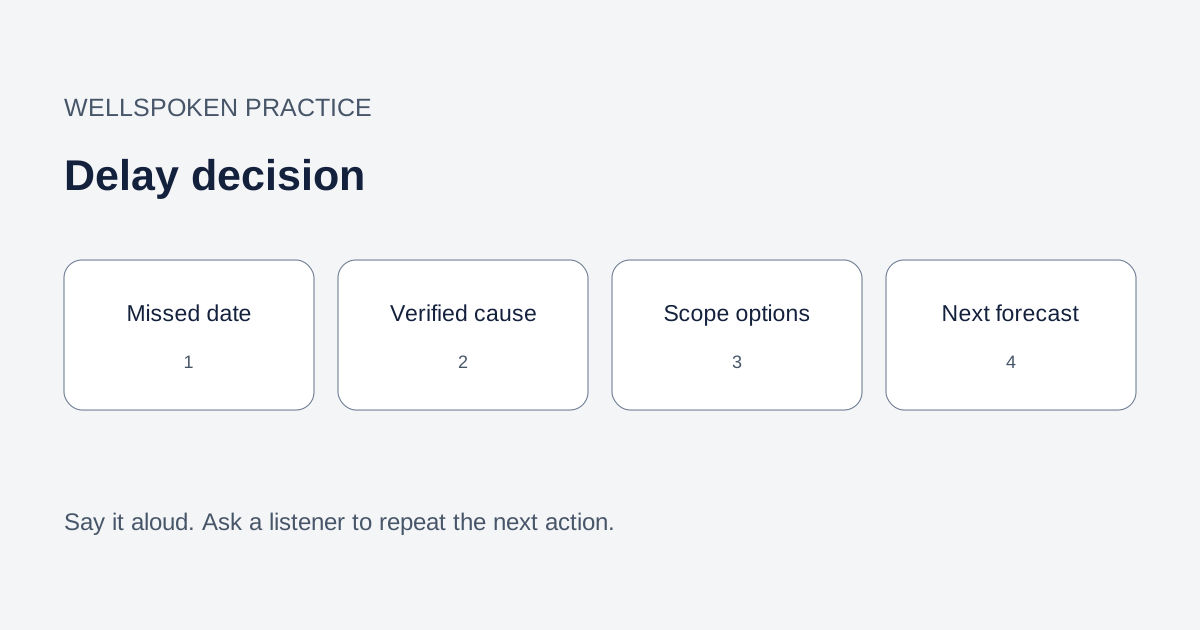
Communicate a delay early by stating the commitment that will be missed, the verified cause, the impact, and the recovery options with their tradeoffs. Early delay communication protects options. A late, defensive explanation forces stakeholders to discover impact after mitigation time has already disappeared.
Why delayed bad news removes options
Delay announcements become painful when the speaker circles the news. Long context can sound like an attempt to make the audience discover the missed date for themselves. The audience instead needs a stable fact pattern: what changed, why the forecast is credible, and what choice remains.
The GAO Schedule Assessment Guide describes how a reliable schedule can show the effects of a change. The communication should preserve accountability without pretending every cause was controllable. A candid update can include uncertainty, provided the uncertainty has boundaries and a plan for resolution.
State commitment, cause, impact, and choices
1. State the missed commitment
Use a date and deliverable: "The beta will not be ready on October 8." Avoid euphemisms such as "the timeline is evolving," which force listeners to interpret the news.
2. Explain the cause at the right level
Name the condition that changed the forecast and why it was not absorbed. Separate root cause from blame. Stakeholders need enough detail to assess recurrence, not a list of every person involved.
3. Quantify the practical impact
Describe effects on customers, dependencies, revenue, cost, or team load using verified information. When the range is uncertain, provide a range and the event that will narrow it.
4. Offer real recovery choices
Present options whose costs differ, such as reducing scope, moving the date, or adding a validated resource. Recommend one and name the decision deadline.
Compare defensive context with a recovery update
Less useful: "We have run into some unexpected issues, and the team is working very hard, so the date may need to shift a little."
Stronger: "The beta will not be ready on October 8. The vendor API fails under the required load, and the workaround needs another test cycle. We can move the beta to October 15 with full scope, or keep October 8 without bulk import. I recommend moving the date because bulk import is central to the pilot. We need that decision today."
The stronger update distinguishes commitment, cause, impact, and recovery choice. It avoids false certainty while giving stakeholders a decision they can make now.
Rehearse the three hardest follow-ups
Practice the first sentence until you can say it without preamble. Then record a 90-second version containing cause, impact, two options, and your recommendation. Remove any adjective that cannot be verified, including "small," "minor," and "temporary." Replace it with a date, range, or condition.
Practice the delay update against three challenges: "Why did we learn this now?", "Can scope move?", and "What would restore the date?" Answer with evidence and avoid inventing precision.
Use Wellspoken to test whether the missed commitment and recovery options appear early. Validate dates, impact, and authority with the project record and accountable owner.
Commitment and disclosure boundaries
Do not promise a recovery date before the team has tested the assumptions behind it. In an incident, legal matter, or personnel case, coordinate wording with the responsible owner. Accountability also requires follow-through: document the decision and return with the next forecast at the time you named.
Some delay notices create contractual, regulatory, or customer obligations. Coordinate with the authorized owner before promising dates, credits, scope changes, or public explanations.
Separate recovery scenarios
Prepare best-supported, lower-bound, and trigger-based scenarios without calling them best case and worst case unless the evidence supports those labels. State which assumptions produce each date and what action changes the range. A stakeholder should be able to choose scope, sequence, or resource tradeoffs without treating the most optimistic date as a new promise.
Project-delay FAQs
When should I communicate a likely delay?
Communicate when evidence makes the commitment materially at risk, even if the final date is still uncertain. Label probability and the next update point.
How much detail should I give about the cause?
Give the verified cause at the level stakeholders need to assess impact and options. Avoid blame, speculation, and technical detail that does not change action.
Should I propose a new date immediately?
Offer a range or checkpoint when evidence is incomplete. A precise unsupported replacement date creates a second commitment problem.
Related practice for delay updates
For delay updates, pair the meetings library with cause-and-effect explanations.
Rehearse a delay update and its three hardest follow-ups in Wellspoken.
What should you say when a new date is still unknown?
Use a checkpoint that produces evidence. In this fictional example, a supplier has missed the data handoff needed for testing:
"Friday's report is at risk because the data file has not arrived. I have confirmed the request and followed up with the supplier. I cannot support a replacement delivery date yet. At 2 p.m. tomorrow I will confirm whether we have usable data. If we do, I will send a tested forecast; if we do not, I will bring a reduced-scope option."
The checkpoint is a commitment to an update, rather than a disguised promise to finish. Put the dependency and next contact in the project record. If the supplier controls the input, name your own follow-up action instead of assigning the supplier a deadline they never accepted.
Now rehearse a skeptical follow-up: "You promised Friday. Why should we believe the next date?" Explain what the previous estimate assumed, which assumption failed, and what new evidence the next forecast will include. If that evidence does not exist, say what remains unknown. A persuasive delivery cannot make an untested estimate reliable.
Prepare the headline with meeting answer structure, then preserve the evidence that changes the forecast.