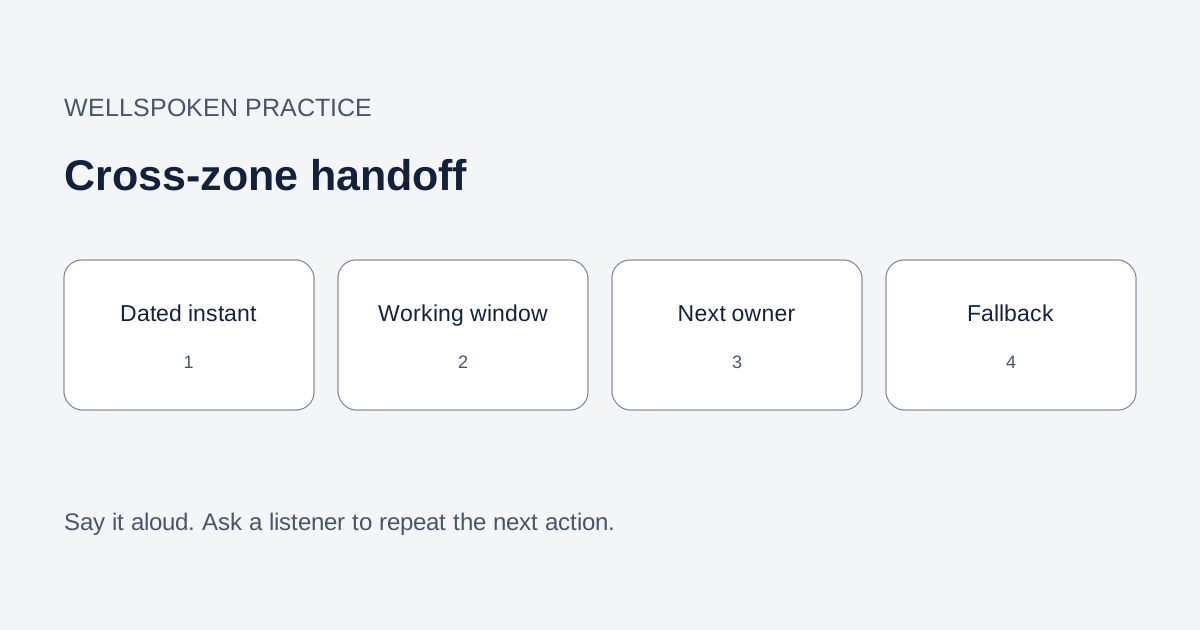
Communicate across time zones by writing the full date, time, and named zone, including a shared calendar link, and stating whose working day owns the handoff. Use UTC offsets carefully because daylight-saving changes can alter them. Repeat critical deadlines in the recipient's local time when the system supports it.
"Tomorrow morning" depends on the reader. Even "PST" can be used incorrectly during daylight time. Distributed teams need language and tools that survive geography, calendar boundaries, and changing offsets.
Write an unambiguous timestamp
Use a format such as "September 22, 2026 at 9:00 a.m. America/Los_Angeles" with a calendar event. For technical records, an RFC 3339 timestamp can include the numeric offset. Human messages still benefit from the named zone.
Separate deadlines from handoffs
A deadline states when work must finish. A handoff states who owns the next action during which working window. Write both: "Seoul completes review by end of day Wednesday; Toronto picks it up at 9 a.m. Thursday local time."
Protect local working hours
Show each participant's working window and avoid treating asynchronous work as 24-hour availability. Rotate recurring inconvenience. Mark a truly urgent request with the decision impact and escalation path rather than relying on "ASAP."
Account for daylight-saving changes
IANA maintains time-zone rules that change with political decisions about offsets and daylight saving. Use an up-to-date calendar for the conversion. Recheck recurring meetings around seasonal changes because different regions change on different dates or not at all.
Close the loop in a durable channel
Summarize what was completed, what remains, the next owner, and the authoritative document. A handoff should let the next region begin without waking the previous one for basic context.
Words to adapt
"The draft is due September 22 at 5:00 p.m. Europe/London. London will post the reviewed file and open questions before signing off. Vancouver owns the next pass starting at 9:00 a.m. local time September 22. The calendar event shows each participant's local conversion."
Write a follow-the-sun handoff packet
Use six fields: completed, current state, next action, owner, blocker, and authoritative link. Add an explicit "no change" where silence could be misread. Date the packet with a named zone and calendar link. The next region should be able to start without reopening chat history or waking the previous owner for basic context.
Audit ambiguity and scheduling burden
Audit missed deadlines for interpretation errors before blaming execution. Was the date complete? Was the zone named? Did the calendar conversion match the message? Did ownership cross a weekend or holiday? Track recurring meeting burden by participant local time and rotate it. Clear timestamps prevent mistakes, while equitable scheduling prevents one region from continually paying for global coordination.
Make urgency legible across an offline boundary
Create three request labels with agreed meanings: normal, deadline-bound, and incident. Every deadline-bound or incident request must state impact, decision time, current owner, next owner, and fallback if the recipient remains offline. Avoid "urgent" as a substitute for planning. Test the labels by sending fictional handoffs through two regions and asking recipients what they would do first. If interpretations differ, revise the fields and examples in the team handbook. The goal is predictable action without turning every notification into a demand for global availability. A clear escalation path protects rest as well as delivery.
Write dates for the reader, not only the system
A machine-readable timestamp helps software, while a human message still needs plain context. Pair the calendar event with a sentence such as "The review closes on the full date shown in the calendar invitation at 5 p.m. Europe/London; use the invitation for your local conversion." For a global audience, show local conversion through the calendar rather than listing a wall of zones. Repeat the date when crossing midnight, since the same moment can fall on different calendar days.
Limits and responsible use
Time-zone clarity does not solve unfair distribution of inconvenient hours. Track who repeatedly joins early or late and rotate the burden. Avoid exposing personal location details beyond what scheduling requires.
Continue with a precommunication checklist and practice concise handoffs.
Frequently asked questions
Should we use utc for everything?
UTC is useful for systems and global references. Human collaboration often benefits from named local zones and calendar conversion alongside UTC.
Are abbreviations like est safe?
They are often ambiguous or seasonally wrong. Prefer an IANA zone name, full date, and calendar event.
How should "end of day" be written?
Name the date, time, and zone, or define the recipient's local working-day convention in the team handbook.
What should a handoff say when the next owner is offline?
Use a complete state description. This fictional packet works even when the sender has signed off:
"Customer export: validation passed on the sample; the full file has not been checked. Next owner: the London operations lead during their next agreed working window. Action: validate the full file using the linked checklist. Do not send it to the customer until that check passes. If validation fails, leave the file unchanged and tag the release owner in the project record."
Add the actual deadline as a calendar-linked instant with its date and zone. Check the conversion in your team's calendar instead of calculating a future offset from memory. Keep the state description separate from the timestamp so a copied message does not lose either.
For rehearsal, give the packet to someone outside the project. Ask which file they would open, whether sending is authorized, and what they would do after a failed check. If they need the original chat to answer, add the missing information. This tests the handoff itself; it does not require someone to adopt another region's working hours.
Keep the handoff readable with one-sentence summaries, while preserving the exact deadline and next owner.