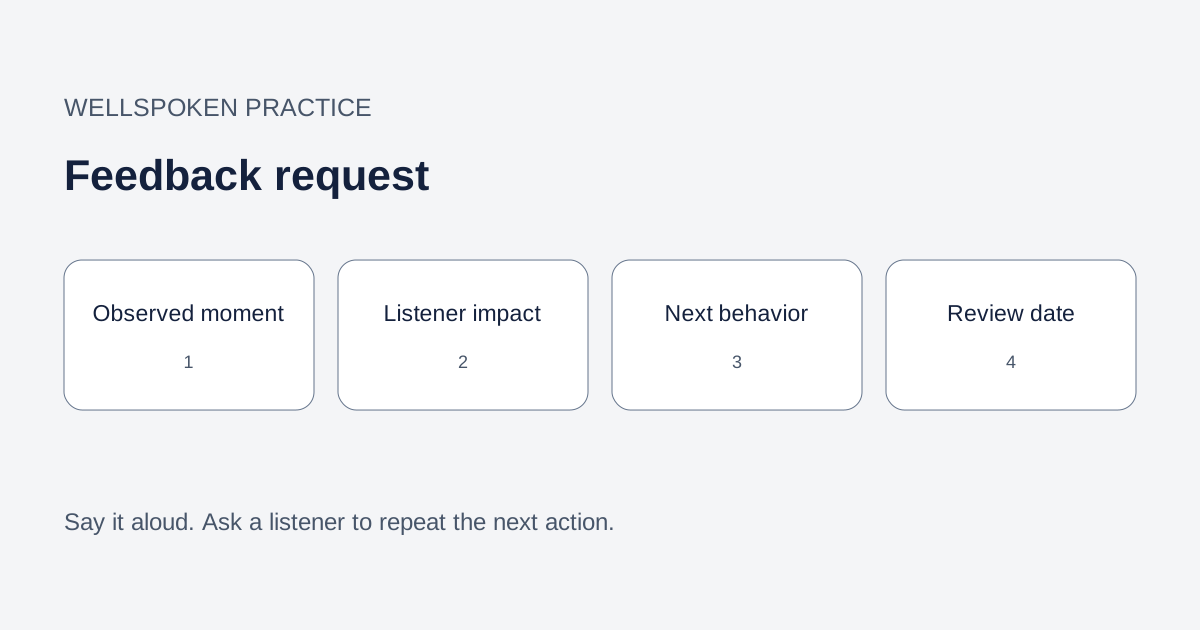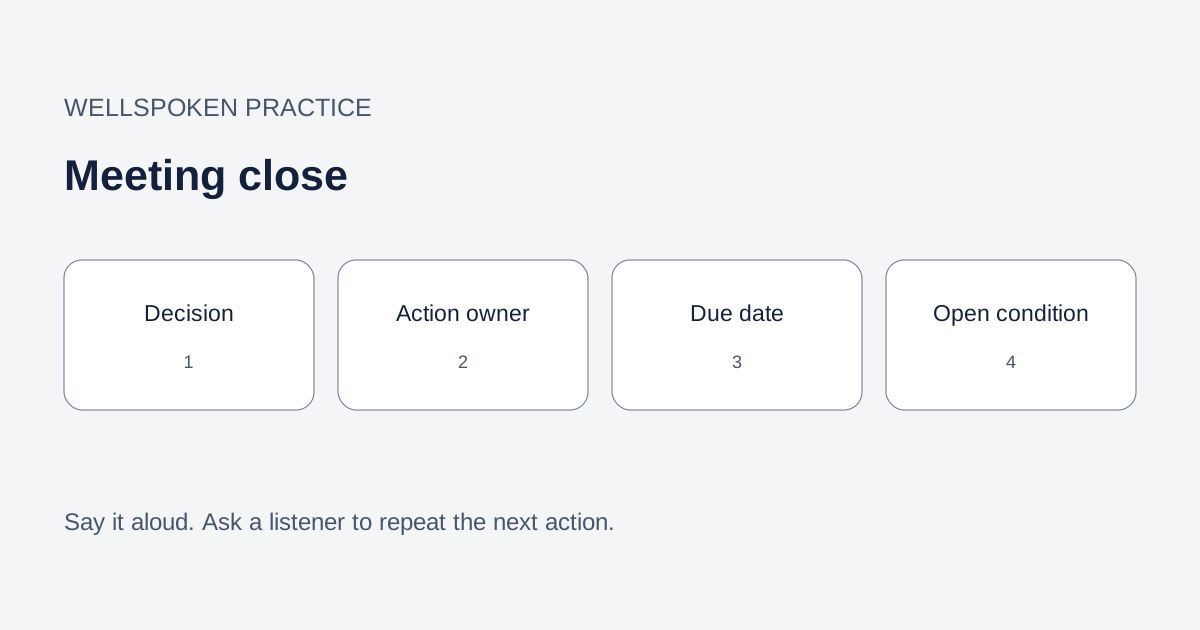
Close a meeting by reading back the decision, assigning an owner and date to each action, and naming unresolved conditions. Ask participants to correct the record before everyone leaves.
Use the close to check the group's operating record.
Protect the closing window
Reserve the final five minutes on the agenda. Give a warning when the meeting reaches that point: "We have five minutes left, so I am moving us into decisions and actions." If the current topic needs more time, choose explicitly whether to extend, defer, or shorten another item.
Do not wait for the calendar notification to start the close. People may already be leaving for the next call.
Read back decisions before actions
Start with what the group decided:
"We approved the three-account pilot for October. The success measures are activation within seven days and fewer than two support escalations per account. The full rollout is not approved yet."
This distinction matters. Teams often leave with actions attached to different understandings of the decision. Include boundaries and conditions where they change execution.
If no decision was reached, say so: "We did not choose a vendor. The remaining question is data residency, and procurement will return with that information Thursday." An unresolved decision should not be disguised as progress.
Convert verbs into owned commitments
Statements such as "We should check with legal" or "The team will update the plan" are not assignments. Name one owner, outcome, and date:
"Elena will obtain legal's answer on the retention clause and post it in the decision document by Thursday at noon."
The owner may coordinate other people. One name prevents collective ownership from becoming no ownership.
Ask the owner to confirm the commitment. They may know about a conflict or missing dependency that the group does not.
Name the next decision
Instead of "We will regroup next week," say what the next checkpoint must accomplish:
"At Tuesday's review, we will decide whether the pilot is ready to begin. The inputs are the legal answer, implementation estimate, and customer list."
This lets participants prepare for the purpose rather than attend another general discussion.
Capture risks and dissent
When a participant raised a serious concern, do not erase it from the cheerful summary.
"The team chose the October date. Reliability remains a red risk, and Omar recommends a one-week delay. He will run the recovery test before Friday's go/no-go review."
Record the concern so the team can revisit the decision if its assumptions change.
A two-minute closing script
"Before we end, here is my record. We decided to launch the pilot with three accounts and review results after two weeks. Maya owns customer selection by Wednesday. Theo owns the support guide by Friday. Legal's retention answer is still open; Elena will post it Thursday. The next decision is pilot readiness at Tuesday's 10 a.m. review. Did I miss or misstate any decision, owner, or date?"
After corrections: "I will send the written record in the project channel within an hour."
That close is short enough for a routine meeting and precise enough to act on.
When the meeting ends without enough time
Send a provisional record promptly and label what requires confirmation. Do not invent ownership after the room leaves. Write: "The discussion suggested Maya as owner, but we did not confirm. Maya, can you confirm or identify the correct owner by noon?"
If rushed closes happen repeatedly, reduce agenda scope or shorten discussion earlier. Better notes cannot compensate for a meeting designed with no decision time.
Let the written record support the spoken one
Use the same words in both. A written recap that subtly changes the decision creates a new dispute. Link to source documents rather than attaching several competing versions.
The record should remain accessible to absent stakeholders and future team members. Follow organizational requirements for sensitive or regulated information.
Close different meeting types differently
A decision meeting closes with the decision, rationale boundary, dissent, and implementation owner. A working session closes with the artifact produced, unfinished sections, and the next work block. A status meeting closes with changed status, new risks, and escalations. A brainstorming session closes with how ideas will be evaluated and who owns selection.
Using the same generic "Thanks everyone, I will send notes" for every format hides the result. Name the kind of progress the meeting was designed to produce.
Audit the actions one week later
Review whether assigned actions entered a real system and whether owners understood them. If commitments repeatedly disappear, diagnose the close: were actions phrased as suggestions, were owners absent, were dates unrealistic, or did nobody have authority to commit resources?
Do not solve weak closure by sending louder reminders. Improve how the commitment is formed. An owner who objects during the close provides useful information earlier than an owner who silently misses the date.
Practice closing a messy discussion
Take notes from a recent meeting and deliver a two-minute close aloud. Ask a colleague to identify the decision, owner, date, open risk, and next checkpoint. Any element they cannot find needs clearer language.
The one-sentence summary exercise develops the recap skill. structured meeting answers helps carry the commitments forward.
Wellspoken can help you rehearse the close until it sounds concise rather than rushed. Download Wellspoken to practice turning discussion into next steps.
What should you say when approval is conditional?
Practice a close where the group agrees to proceed only if a test passes. The fictional meeting record contains "pilot approved," "security test Friday," and "customer invited Monday." Read it back carefully:
"We approved preparing the pilot. Inviting the customer depends on Friday's security check passing. Priya owns the check and will post the result. Sam will prepare the invitation but will send it only after the release owner confirms the result. If the check fails, Monday's invitation is on hold and we will choose the recovery plan. Is that the condition we agreed to?"
Ask a partner to point out which action can begin now and which requires a later decision. If the answers differ, rewrite the condition. A date beside an action does not establish permission to take it.
Use the same distinction when no owner is present. Name a follow-up to obtain the owner's agreement, rather than recording that person as committed. For the final rehearsal, have a participant dispute one sentence in your close. Correct the spoken record before sending the written one so there is a single agreement to work from.
Practice shorter work answers when the closing window keeps running out.
Write a recap an absent teammate can use
Lead with the decision and its status, then give the reason, owner, deadline and unresolved question. In a fictional recap: "We chose a limited launch, conditional on the rollback retest. Arun owns the test; Mei will update customers after the result. The support schedule remains open." Link the current decision record so readers can inspect the context.
Distinguish proposals from decisions and disagreement from an action item. Invite participants to correct factual errors. Share recordings or transcripts only within applicable consent, access and retention rules. Practice summarizing a mock meeting for someone who did not attend. Ask them what to do next and what still needs approval; revise any part they must infer.
Read the decision back while the owners are present
End a decision item with a short read-back: what was chosen, why, who owns the work, when it is due and which condition remains open. A fictional facilitator says: "We chose the smaller launch because support capacity is limited. Jo owns the cohort plan for Thursday. Expansion still needs a separate decision."
Ask the named owners to correct the record. If the group has only a proposal, say so; silence is not a substitute for the authorized decision. Record a deferral with its missing fact and return date. In rehearsal, ask a partner to change one deadline during the recap. Check that you update both the spoken summary and the written action, so the group leaves with one usable record.