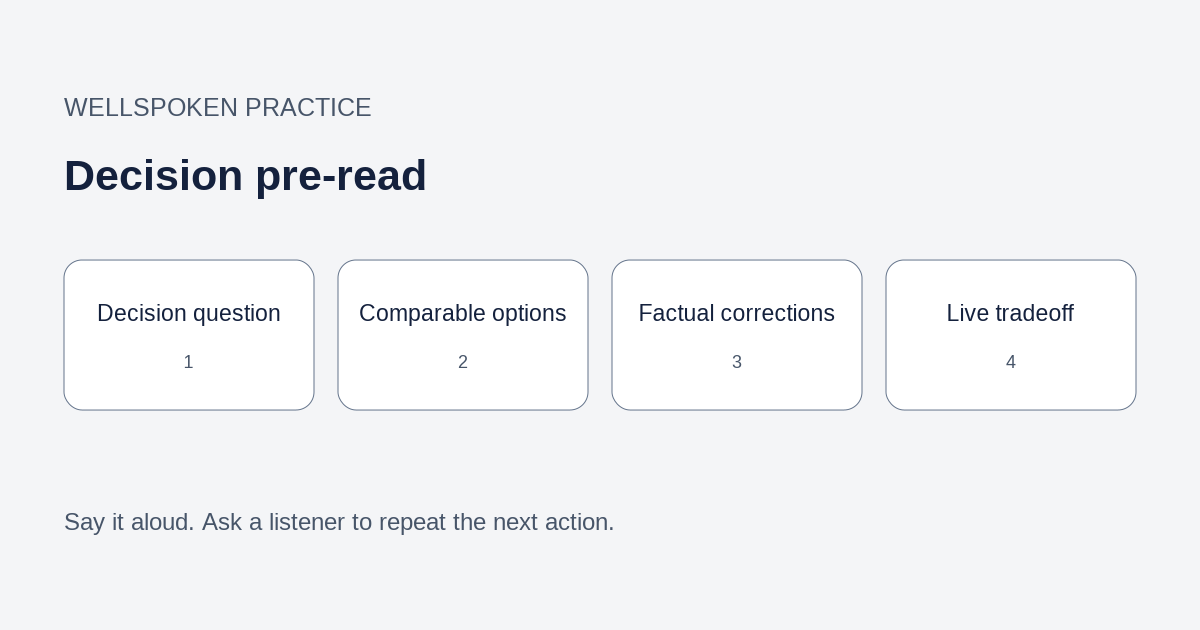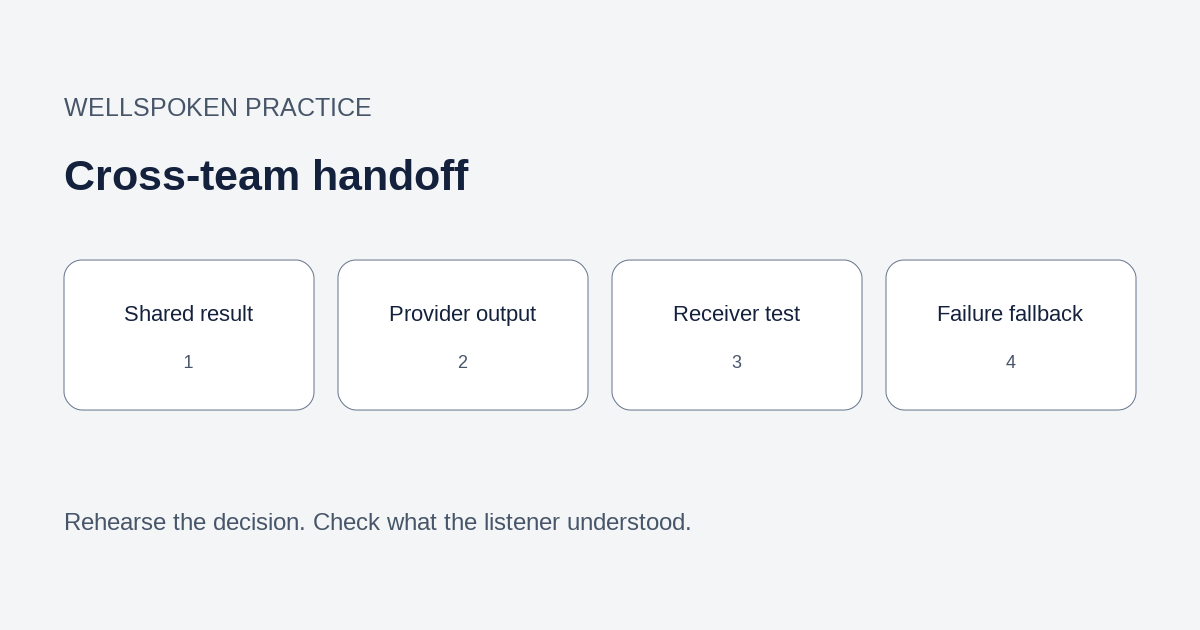
In cross-functional meetings, begin with the shared outcome, translate specialist language into consequences, and make each dependency an explicit agreement between owners. Ask the receiver to describe what they need before treating the provider's work as complete.
Why interfaces create cross-functional confusion
Cross-functional confusion often sounds like disagreement. Engineering discusses feasibility, marketing discusses timing, finance discusses exposure, and support discusses customer load. Each function may be correct inside its own frame while the group lacks a shared decision model.
The Scrum Guide describes transparency as making the work visible to people doing it and receiving it. The handoff exercise below applies that principle to a boundary between teams; it is not a claim that every team uses Scrum.
Translate every dependency into an agreement
1. Open with the shared outcome
Name the customer or business result before the functional plans. Return to it when local optimization pulls teams apart.
2. Translate consequence, not every detail
Explain what specialist information changes for another team: date, capacity, risk, cost, or experience. Define unavoidable terms once.
3. Expose the interface
State what one team provides, what another team needs, and the acceptance condition. Hidden dependencies become late surprises.
4. Confirm owners across the boundary
Assign a sender and receiver for each handoff. Read back the date and evidence that marks the handoff complete.
Compare specialist narration with an interface statement
Less useful: "Backend will finish the migration and then mobile can integrate once the schema work is done."
Stronger: "The shared outcome is an October 8 beta with account history intact. Backend will provide the versioned schema and sample payload by Tuesday. Mobile will confirm it can render all required fields by Thursday. The interface is complete when both teams pass the same five sample accounts."
The stronger version translates specialist work into a consequence for the shared outcome and names the two owners who must coordinate. It gives the group an agreement to inspect.
Run a three-team handoff simulation
Choose one technical update from your function. Explain it three ways: to your own team, to a neighboring function, and to an executive. Keep the facts constant while changing the consequence you lead with. Ask listeners to repeat the dependency and next owner.
Simulate a handoff among product, engineering, and support. Each person must state what they provide, what they need, and how both sides will know the interface is complete.
Rehearse a handoff aloud in Wellspoken, then have the actual provider and receiver check the dependency and decision rights.
When incentives or authority conflict
Translation should not erase technical constraints or professional judgment. Bring specialists into decisions that depend on their expertise. Some interface disputes reflect incompatible incentives or authority and need a decision owner, not another round of clearer wording.
Stress-test one dependency
Choose a dependency between two teams. The provider states what will be delivered and the receiver states how it will be used. Compare their definitions of complete, timing, format, and fallback. Any mismatch becomes an explicit meeting decision. Repeat the agreement in one sentence that names both owners and where evidence of completion will appear.
Add a dependency failure scenario
Add one failure scenario to the handoff: the artifact arrives late, incomplete, or in the wrong format. The receiver states the consequence and fallback; the provider states the earliest warning signal. This turns a brittle dependency into a monitored agreement and shows whether each team understands the other's operational reality.
Cross-functional meeting FAQs
How do I translate technical detail without oversimplifying?
Lead with the consequence, then keep the technical mechanism available for the people who must verify or implement it.
What should every cross-functional handoff include?
Name provider, receiver, artifact or decision, completion evidence, deadline, and the consequence of delay.
What if teams use the same word differently?
Pause and define the term with an example. Add the agreed meaning to the shared record rather than relying on memory.
Related practice for cross-functional handoffs
For cross-functional handoffs, pair the meetings library with one-sentence summaries.
Practice one cross-functional handoff with a provider, receiver, artifact, and deadline in Wellspoken.
Test what "ready" means to each team
Use a fictional launch involving product, engineering, and support. Engineering says the feature is ready because the code is deployed. Product means the approved workflow is available to the pilot accounts. Support means staff can answer questions using an up-to-date guide. The same word hides three separate checks.
Ask each team to finish the sentence: "We can begin our next action when we can see..." Record the artifact or state they name. Then agree which checks must pass before the customer receives an invitation.
For the second rehearsal, make the support guide arrive after the planned invitation. The invitation owner should state whether they can pause it and who decides on the alternative. A handoff with no fallback leaves the receiving team carrying an unstated deadline risk.
End with a read-back from the receiver. The provider's explanation is only half of the agreement. Check that the receiver names the same version, completion test, and next action. Put the agreement beside the work record so a replacement teammate can use it without reconstructing the meeting. This exercise tests shared meaning and ownership; it does not replace technical acceptance testing.
Use the ELI5 explanation method to translate an unfamiliar mechanism while keeping its operational consequence clear.