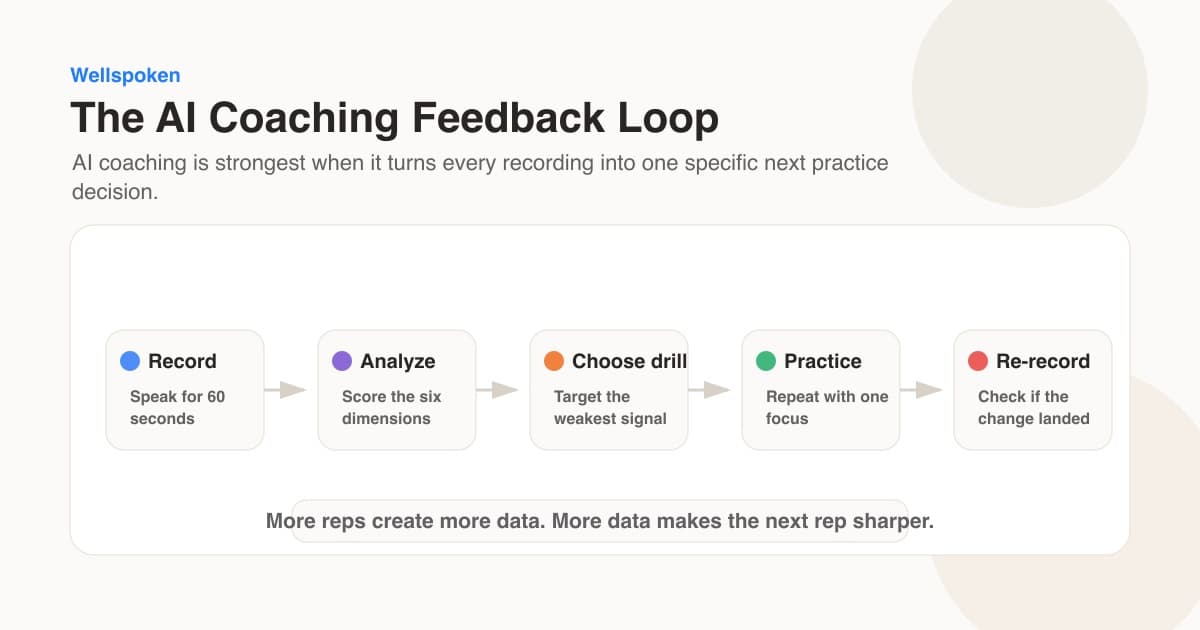
Summary: AI gives useful tone feedback when it describes observable signals such as pace, pauses, pitch movement, emphasis, and word choice, and you decide whether those signals fit the listener and the situation.
Ask for feedback on a moment you can replay. A useful report might identify a pause before a request or a change in speaking speed. You still need the situation and the intended listener to decide whether to change it.
That distinction matters. Researchers describe prosody as the sound pattern of speech, including rhythm, pitch, timing, and loudness. Those cues carry information, but a major review of emotional prosody also warns that the mapping from acoustic features to emotion remains complex. A quiet voice could signal care, fatigue, concentration, or a poor microphone. Software sees a pattern; it does not automatically know the situation.
Use the Intent, Signal, Replay check
Before recording, name the impression you want to create. After recording, inspect the signals that a listener can actually hear. Then replay the answer as if you were the recipient.
| Step | Question | Evidence to inspect |
|---|---|---|
| Intent | What should the listener feel or understand? | One target such as calm, direct, warm, or urgent |
| Signal | What did the delivery communicate? | Pace, pauses, emphasis, pitch movement, volume, hedging, endings |
| Replay | Did those signals fit this situation? | The recording in context, not a score in isolation |
Use this Intent, Signal, Replay check as a coaching worksheet. If your aim is a calm delivery, an instruction to add energy may be irrelevant. Write down what you want the listener to understand before changing your voice.
Microsoft's speech documentation offers a useful boundary for what software can observe. Its prosody assessment evaluates stress, intonation, speaking speed, and rhythm. Those are measurable characteristics. “You sound angry” is an interpretation that needs much more context.
A concrete tone correction
Imagine a manager responding after a project delay:
Before: “Yeah, okay, I guess we can move the date again?”
The words and rising ending may sound reluctant or unsure, even if the manager intends to be supportive. A more useful revision changes both language and delivery:
After: “We can move the date. Send me the revised plan by three, and I’ll help clear the blocker.”
In this fictional example, the second version states the decision and request directly. Whether it feels supportive depends on the relationship and how the manager delivers it. Ask a listener to explain that reaction rather than assuming the wording guarantees warmth.
Score your own attempt with this lightweight rubric:
| Dimension | 0 | 1 | 2 |
|---|---|---|---|
| Intent | No target | Vague target | One specific listener impression |
| Language | Conflicts with intent | Mostly fits | Reinforces intent |
| Delivery | Distracting mismatch | Mixed signals | Pace, emphasis, and endings fit |
| Specificity | General impression only | One example | Exact timestamp and adjustment |
The rubric has no validated pass score. Use the rows to explain a choice between two recordings. A listener may reasonably prefer a different version; ask which words or delivery moments shaped that judgment.
What good AI feedback sounds like
Useful feedback is specific and editable:
- “Your last three statements rise at the end; repeat them as complete declarations.”
- “The opening is faster than the rest; pause after the decision.”
- “You use ‘maybe’ before the request; remove it if the decision is settled.”
Weak feedback assigns a label without evidence: “You sound unconfident” or “Be more charismatic.” Ask any tool to show the moment, name the observable signal, and suggest one revision.
Keep any app feedback tied to your recording and chosen task. For a sensitive conversation, a person familiar with the context can check whether the wording is appropriate before you use it.
For a closer look at the measurement framework, read what the Wellspoken Index measures. For a broader tool-selection rubric, see how we rate AI speech coaches.
A five-minute practice
- Choose a real sentence you need to say this week.
- Write one intended impression: calm, candid, warm, firm, or urgent.
- Record two versions with different pace and emphasis.
- Score both with the rubric above.
- Keep the version that fits the listener and situation, not the one with the highest “energy.”
Repeat the same sentence at a comfortable pitch. Change one pause or one stressed word, then describe the difference you hear. Keep the change small enough to repeat naturally.
Try the Intent, Signal, Replay check on one real message in Wellspoken, then make one evidence-based adjustment before you record again.